
Effective Content Moderation Using Micro Task Workers
Published on Tháng 2 3, 2026 by Admin

As a social media platform owner, you face a monumental challenge. Every minute, users upload a massive amount of content. Consequently, maintaining a safe and positive community is more difficult than ever. Traditional content moderation methods often struggle to keep up. They are expensive, slow, and can lead to moderator burnout. However, there is a powerful and efficient solution: micro tasks.
This article explores how breaking down content moderation into micro tasks can revolutionize your platform’s safety strategy. We will cover the benefits, from cost savings to scalability, and provide a clear path for implementation. Ultimately, you will learn how to create a safer online environment while improving operational efficiency.
The Growing Challenge of Content Moderation
The digital world is expanding at an incredible rate. As a result, the volume of user-generated content is exploding. Your platform must review photos, videos, text, and comments constantly. This sheer scale presents a significant hurdle for any moderation team.
Furthermore, harmful content evolves quickly. New slang, memes, and symbols emerge that can bypass automated filters. Human moderators are essential for understanding context and nuance. On the other hand, relying solely on an in-house team creates bottlenecks and slows down response times, which damages user trust.
The High Cost of Traditional Moderation
Hiring, training, and retaining a large, full-time moderation team is incredibly expensive. These fixed costs can strain your budget, especially during periods of rapid growth. Moreover, the psychological toll on moderators is immense. Constant exposure to toxic content leads to high rates of burnout and turnover, which further increases costs.
What Exactly Are Micro Tasks?
Micro tasking is a method of breaking a large, complex project into small, simple, and independent tasks. These tasks can then be distributed to a large pool of remote workers. Each worker completes a small piece of the puzzle. When combined, their efforts solve the larger problem efficiently.
In content moderation, this means a single piece of content might pass through several hands. For instance, one worker might check for hate speech, while another verifies if an image is graphic. This distributed approach is the key to its power.
Examples of Moderation Micro Tasks
Content moderation can be broken down into many simple jobs. This allows for focused and fast decision-making. Here are a few examples:
- Image Tagging: Is this image safe for work? Does it contain violence, nudity, or other policy violations?
- Text Classification: Does this comment contain bullying, spam, or personal information?
- Video Segment Review: Watch a 10-second clip and identify any violations.
- Audio Transcription and Analysis: Transcribe a short audio clip and flag any harmful language.
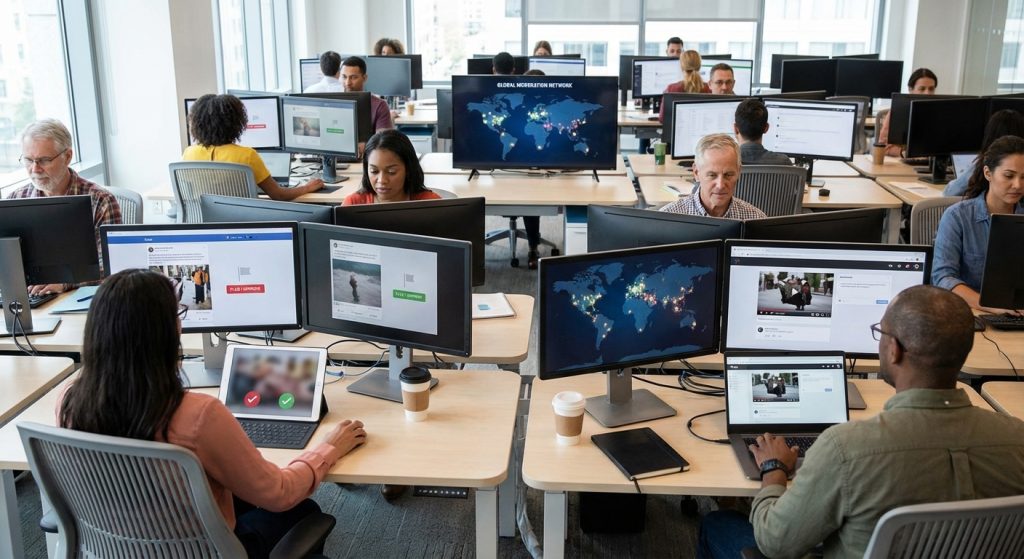
Each task is designed to be quick and require minimal context. Therefore, workers can process a high volume of content accurately in a short amount of time.
Why Micro Tasks Are a Game-Changer for Platforms
Adopting a micro task model for content moderation offers numerous advantages over traditional methods. It provides a flexible, scalable, and more humane way to manage your platform’s content. Ultimately, this leads to a safer community and a healthier bottom line.
Unmatched Scalability and Speed
A major benefit of micro tasks is elasticity. You can instantly scale your moderation workforce up or down to meet demand. For example, if a post goes viral, you can deploy thousands of workers to moderate the comments in real-time. This prevents backlogs and ensures harmful content is removed swiftly.
A distributed workforce means you are no longer limited by the size of your in-house team. You can handle any content spike without a drop in performance.
Significant Cost Reduction
Micro tasks operate on a pay-per-task model. This transforms your moderation costs from a fixed overhead into a variable expense. You only pay for the work that is done. This approach is far more economical than maintaining a large team of full-time employees. As a result, you can cut operational costs with micro-tasking and reallocate those funds to other growth areas.
Improved Accuracy Through Consensus
With micro tasks, you can have multiple workers review the same piece of content. This is known as a consensus or redundancy model. For example, if three out of five workers flag an image as inappropriate, the system can automatically take action with high confidence.
This process reduces individual bias and human error. Consequently, moderation decisions become more consistent and accurate across the board. It creates a system of checks and balances that is difficult to achieve with a single moderator.
Enhanced Moderator Wellbeing
The mental health of content moderators is a serious concern. By breaking down moderation into small, decontextualized tasks, you limit any single worker’s exposure to disturbing material. A person might only review a few seconds of a video or a single comment, rather than an entire toxic thread.
This task redistribution is a powerful tool for reducing burnout through task redistribution. It creates a healthier work environment and shows a commitment to ethical operations, which can improve your brand’s reputation.
How to Implement a Micro Task Moderation System
Transitioning to a micro task system requires careful planning. However, the process is straightforward and can be broken down into a few key steps. Following this framework will ensure a smooth and successful implementation.
Step 1: Define Clear Moderation Policies
Before you can create tasks, you need unambiguous guidelines. Your moderation policy must be extremely detailed. Use clear language and provide specific examples of what is and is not allowed. These policies are the foundation of your entire system.
Step 2: Break Down the Workflow
Next, analyze your moderation process. Identify the distinct decisions a moderator makes. Each decision point can become a micro task. For instance, instead of asking “Is this post okay?”, you could create separate tasks: “Does this post contain profanity?”, “Is the image graphic?”, and “Is this an advertisement?”.
Step 3: Choose the Right Platform or Partner
You have two main options for implementation. You can build your own micro task platform, which offers full control but requires significant engineering resources. Alternatively, you can partner with an established micro tasking service. These services provide access to a global workforce and existing infrastructure, allowing for rapid deployment.
Step 4: Implement Quality Control
Quality is paramount. To ensure accuracy, you must implement robust quality control mechanisms. This includes:
- Gold Standard Tasks: Insert tasks with known answers into the queue to test worker accuracy.
- Worker Reputation Scores: Track the performance of each worker over time and give more weight to high-performers.
- Regular Audits: Have your internal experts periodically review a sample of the micro task decisions to ensure they align with your policies.
Conclusion: The Future of Safe Social Platforms
In conclusion, content moderation is a non-negotiable part of running a social media platform. The challenges of scale, speed, and cost are immense. Micro tasks offer a modern, effective, and humane solution to this problem.
By breaking down complex moderation into simple, distributed tasks, you can build a system that is scalable, cost-effective, and highly accurate. More importantly, it protects both your users and your moderators. Embracing this model is a crucial step toward building a safer and more successful digital community.
Frequently Asked Questions (FAQ)
How can micro tasks handle complex moderation cases?
For complex cases requiring deep context, a hybrid model works best. Micro tasks can handle the high volume of simple content. This frees up your expert, in-house moderators to focus their time on the most difficult and nuanced cases. The system can automatically escalate content that micro task workers flag as ambiguous.
Aren’t automated AI tools enough for moderation?
AI is a powerful tool, but it is not a complete solution. AI struggles with nuance, sarcasm, and evolving cultural contexts. Micro task workers provide the human intelligence needed to complement AI. For example, AI can flag potentially problematic content, and a human micro-tasker can quickly provide the final verification.
How do I ensure data privacy with a distributed workforce?
Data privacy is critical. Reputable micro task platforms have strict security protocols. This includes anonymizing user data, breaking content into fragments so no worker sees the full context, and enforcing strong NDAs. When choosing a partner, be sure to vet their security and privacy practices thoroughly.
What is the cost of implementing a micro task system?
The cost varies. If you partner with a service, you typically pay per task, with prices ranging from a fraction of a cent to a few cents per decision. This is significantly cheaper than the fully-loaded cost of a full-time employee. Building your own system involves upfront development costs but can be cheaper at an extremely large scale.
