
Skills, Not Papers: Verifying Informal Labor Talent
Published on Tháng 1 29, 2026 by Admin

The global informal economy is a massive ecosystem of talent. It includes millions of skilled carpenters, electricians, caregivers, and artisans. However, these workers often face a significant barrier. They lack the formal credentials to prove their abilities. As a result, this creates a trust deficit that limits their economic potential. EdTech innovators have a unique opportunity to solve this problem by building new systems for skill verification.
This article explores the challenges and solutions within informal labor talent ecosystems. We will examine why traditional methods fail and how technology can create a more equitable and efficient future of work. Ultimately, verifying skills is the key to unlocking immense human potential.
The Trust Deficit in the Informal Economy
The informal sector represents a substantial part of the global workforce. Many individuals in this sector possess valuable, hard-earned skills. For instance, a mechanic might have a decade of experience but no formal diploma. A talented seamstress may have learned her craft through a family apprenticeship, not a technical college.
The central problem is the absence of a trusted validation mechanism. Without degrees or official certificates, workers struggle to signal their competence to potential employers or clients. This uncertainty leads to several negative outcomes. Firstly, it often results in lower wages, as employers price in the risk of hiring an unverified individual. Moreover, it limits job mobility and career progression for the worker.
Consequences of Unverified Skills
For businesses and households, hiring from the informal pool can feel like a gamble. They risk poor quality work, safety issues, or even outright fraud. This friction slows down economic activity. It prevents the efficient matching of skilled labor with market demand. Therefore, a system that can reliably verify skills is not just a convenience; it is an economic catalyst.
This gap in trust keeps a significant portion of the workforce from reaching their full earning potential. It also makes it harder for small businesses to scale by finding the reliable talent they need to grow.
Why Traditional Verification Fails Informal Workers
Traditional hiring methods rely heavily on resumes, academic degrees, and formal employment histories. These tools work reasonably well in the formal economy. However, they are almost completely ineffective for the informal sector. Many skilled workers have limited formal education. Their work history is often undocumented, consisting of cash-based projects and word-of-mouth referrals.
Insisting on a formal resume from a self-taught plumber or a domestic worker is unrealistic. It excludes a vast pool of competent individuals from consideration. Consequently, this deepens the divide between the formal and informal economies. The challenge involves much more than just navigating the risks of informal labor market integration; it requires a fundamental shift in how we recognize and value skills.
A System Built for a Different World
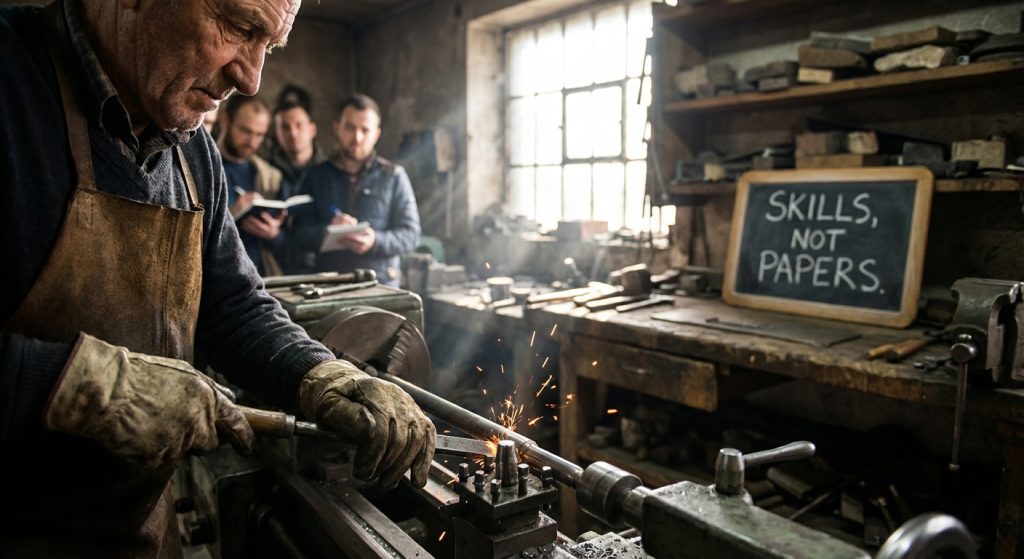
The skills in the informal economy are overwhelmingly acquired through experience. This hands-on learning is incredibly valuable but leaves no paper trail. The old system was not designed to capture this type of value. As a result, we need new models that focus on what a person can do, not what degrees they have collected.
The EdTech Revolution: Building Digital Trust
This is where EdTech innovators can make a profound impact. Technology offers scalable solutions to build trust where it is currently lacking. By creating accessible, mobile-first platforms, we can make skills visible and verifiable for everyone. The mission is to build robust hyper-local service markets and digital trust networks that empower both workers and employers.
These new ecosystems are not about replacing informal learning. Instead, they are about recognizing and validating it. Several promising approaches are emerging as the cornerstones of this revolution.
Micro-Credentials and Digital Badges
Instead of a single, all-encompassing degree, micro-credentials break skills into smaller, verifiable units. For example, an electrician could earn separate digital badges for “Residential Wiring,” “Safety Protocols,” and “Fixture Installation.”
These badges are powerful because they are specific. They tell an employer exactly what a worker can do. Furthermore, they can be earned and displayed on a mobile phone, making them highly accessible. This granular approach allows workers to build a portfolio of proven skills over time.
Mobile-First Assessment Platforms
For skill verification to be inclusive, it must work on the devices people already own. Mobile-first platforms are essential. These platforms can deliver practical, on-demand assessments directly to a worker’s smartphone. This removes the need for physical testing centers.
Assessments can take many forms. A carpenter might be asked to upload a short video of them making a clean cut. A translator could complete a short, timed text translation. These practical tests provide direct evidence of a person’s ability in a way that a multiple-choice test cannot.
The Power of Peer and Client Validation
Another powerful tool is the creation of reputation systems, similar to those used by platforms like Airbnb or Uber. After a job is completed, a client can leave a verified review and rating. Over time, these reviews build a rich, public profile of a worker’s reliability and quality.
Peer validation can also play a role. For instance, an experienced plumber could vouch for the skills of a junior colleague they have mentored. This web of social proof creates a strong trust signal that is often more meaningful than a formal certificate.
Advanced Technologies Shaping the Future
Looking ahead, more advanced technologies are poised to make skill verification even more robust and secure. These innovations promise to create a truly decentralized and worker-centric talent ecosystem.
Blockchain for Tamper-Proof Credentials
Blockchain technology offers a way to create secure, tamper-proof digital records. When a worker earns a skill credential, it can be recorded on a blockchain. This creates a permanent, verifiable entry that cannot be altered or faked.
Crucially, these credentials can be owned and controlled by the worker. They are not tied to a single platform or employer. This gives workers the freedom to carry their verified skill portfolio with them throughout their career, across different jobs and even countries.
AI-Powered Skill Matching
Once skills are accurately verified and digitized, artificial intelligence can play a transformative role. AI algorithms can analyze a worker’s verified skill set and match them with available jobs with incredible precision. This goes far beyond simple keyword matching.
This technology can identify workers with the exact combination of skills needed for a complex project. As a result, it dramatically reduces hiring friction and improves the quality of matches for everyone involved. It ensures that the right talent finds the right opportunity quickly and efficiently.
Conclusion: A More Equitable Future of Work
The challenge of skill verification in informal labor markets is significant, but it is not insurmountable. The lack of formal credentials has long held back millions of talented individuals. It has created friction, risk, and inefficiency in a vital part of the global economy.
However, EdTech innovators are now building the tools to solve this problem. Through micro-credentials, mobile assessments, reputation systems, and blockchain, we can create a new foundation of trust. These technologies make skills visible, portable, and verifiable.
By focusing on what people can do rather than the papers they hold, we can unlock enormous economic potential. This shift promises a more equitable future of work, where every individual has the opportunity to prove their talent and build a better livelihood.
Frequently Asked Questions (FAQs)
Is this type of skill verification only for tech jobs?
Absolutely not. In fact, its greatest impact is on vocational and trade skills. For example, it’s designed for plumbers, electricians, carpenters, caregivers, cleaners, and other hands-on professions where practical ability is more important than a degree.
How can you prevent cheating on mobile-based skill tests?
This is a key challenge addressed through a multi-layered approach. Methods include requiring video evidence of tasks, using GPS to verify location, incorporating time limits, and leveraging peer or client reviews to confirm the quality of actual work performed. No single method is perfect, but a combination creates a reliable system.
What is the biggest barrier to adopting these technologies?
The primary barriers are digital literacy and consistent access to smartphones and data. However, smartphone penetration is growing rapidly worldwide, even in developing regions. Therefore, designing simple, intuitive, and low-bandwidth applications is crucial for widespread adoption.
Can these verification systems replace formal education?
The goal is not to replace formal education but to complement it. These systems are designed to recognize and validate skills regardless of how they were acquired. They can exist alongside traditional degrees, creating a more holistic and inclusive picture of an individual’s capabilities.
