
Advanced Token Embedding for Immersive Soundscapes
Published on Tháng 1 25, 2026 by Admin

Understanding Audio Tokens: The Building Blocks
Before we discuss embedding, we must first understand tokens. Think of an audio file as a long, continuous stream of data. For a computer to understand it, this stream needs to be broken down into smaller, manageable pieces. These pieces are called tokens.Traditionally, a token might just be a small chunk of raw audio. However, modern AI uses a much smarter approach. It learns a “codebook” of fundamental sound components. For example, a model might learn separate tokens for the sound of a raindrop, a gentle breeze, or a specific vocal tone. As a result, any complex sound can be represented as a sequence of these learned tokens.This process is a core component of many modern audio synthesis models. Therefore, optimizing vector quantization, the process of creating these codebooks, is crucial for generating high-quality sound.
What is Advanced Token Embedding?
Simply having tokens is not enough for true understanding. This is where embedding comes in. Token embedding is the process of mapping each discrete audio token into a rich, high-dimensional vector space. In other words, it gives each token a detailed set of coordinates that describe its characteristics.Imagine a library where books are organized by genre. That’s basic tokenization. Now, imagine a library where each book has a specific location based on its genre, author’s style, mood, and relationship to every other book. That is token embedding. Sounds with similar characteristics, consequently, will have embeddings that are close to each other in this vector space.This contextual map allows an AI to understand the relationships between sounds. For example, it learns that the token for “heavy rain” is related to the token for “distant thunder” but very different from the token for “chirping bird.” This understanding is the key to generating complex and coherent soundscapes.
Core Techniques for Complex Soundscape Embedding
Creating rich embeddings for complex soundscapes requires several advanced techniques. These methods allow the AI to capture not just the sounds themselves, but also their scale, position, and meaning within an environment.
Hierarchical Embeddings: From Ambiance to Detail
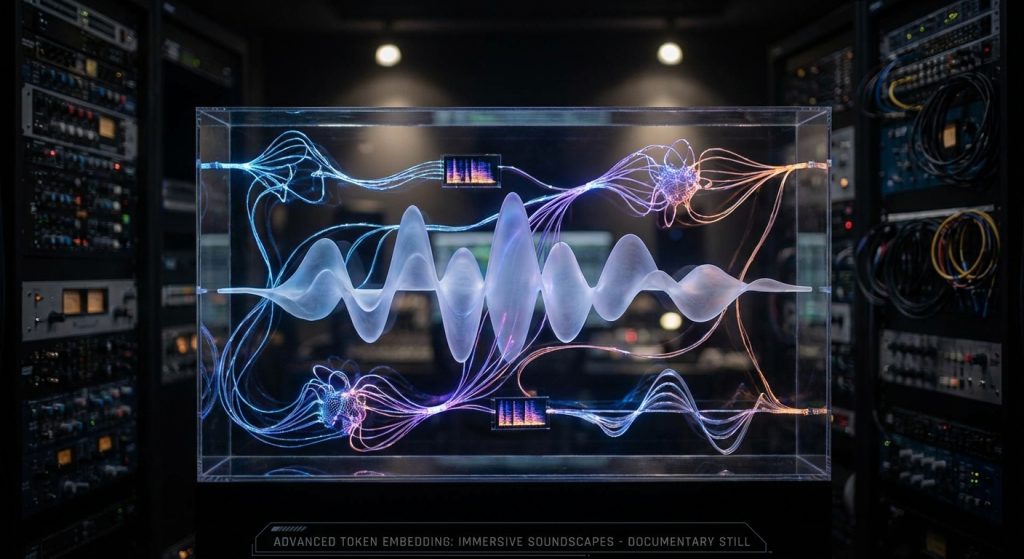
A complex soundscape has layers. You have the broad, ambient background noise, like the hum of a city. In addition, you have specific, high-frequency events, like a car horn or a footstep. Hierarchical embeddings capture this layered nature.This technique uses multiple levels of tokenization. Firstly, a coarse level captures the overall texture and ambiance of the sound. Subsequently, finer levels add specific details on top. For example, the coarse token might define a “forest at night,” while finer tokens add individual cricket chirps and the rustle of leaves. This approach is fundamental to enhancing audio fidelity because it ensures both the big picture and the small details are present and clear.
Spatial Embeddings: Adding the ‘Where’ to Sound
For immersive audio, the position of a sound is critical. Spatial embeddings encode this information directly into the token’s vector. This means the AI doesn’t just know *what* the sound is, but also *where* it is in 3D space.This can be achieved in several ways. For instance, the model can be trained with positional data, learning to associate certain audio transformations (like volume and filtering) with coordinates. As a result, you can prompt a model to generate the sound of a “whisper behind your left ear” or a “jet flying overhead from right to left.” This gives designers incredible control over the spatial mix.
Cross-Modal Context: Linking Sound to Meaning
The most advanced systems use cross-modal embeddings. This technique connects audio tokens to other types of data, such as text or game events. The AI learns to associate the text “footsteps on gravel” with the specific audio tokens that represent that sound.This has enormous implications for audio design. Instead of searching for a specific sound file, you can simply describe the sound you want. Moreover, in a game, the system can generate audio dynamically based on in-game events. For example, the “player running” event could be linked to different audio embeddings depending on the surface material (grass, concrete, wood), creating a perfectly synchronized and realistic experience.
Practical Applications in Immersive Audio Design
These advanced techniques are not just theoretical. They unlock powerful new workflows and creative possibilities for immersive audio designers.
Dynamic Generative Environments
Imagine creating a living, breathing forest that never sounds the same way twice. With generative models using token embeddings, this is possible. You can define the core elements of the soundscape (e.g., wind, birds, insects) and let the AI generate a continuous, non-repetitive audio stream. The system understands how these sounds relate, so it won’t, for example, play the sound of a desert creature in a rainforest.
Intelligent Source Separation
Complex soundscapes often involve overlapping sounds. For instance, you might have a dialogue scene in a crowded restaurant. Token embeddings can help with source separation. Because the model understands the characteristics of a human voice, it can be used to isolate dialogue from the background noise with remarkable clarity. This is incredibly useful for post-production and audio cleanup.
Next-Generation Sound Synthesis
Foley and sound effect creation can be time-consuming. Advanced token embedding allows for powerful sound synthesis from simple prompts. Instead of manually layering sounds to create a monster’s roar, you could prompt a model with “a deep, guttural roar with a wet, gurgling finish.” The AI, understanding the embeddings for each of those concepts, can generate a unique and high-quality effect.
Challenges and Key Considerations
While powerful, this technology has some important considerations. Firstly, training these models requires massive amounts of data. You need large, diverse, and often well-labeled audio datasets to create a robust codebook and embedding space.Secondly, the computational cost can be high. Training and even running these models in real-time often require powerful GPUs. As a result, optimization is key, especially for applications like mobile games or VR on standalone headsets.
Ultimately, the goal is to create a system that understands sound as a human would. It should grasp not just the acoustic properties but also the context, emotion, and spatial relationships within an environment.
Frequently Asked Questions
Do I need to be a programmer to use these techniques?
Not necessarily. While developing models from scratch requires deep programming knowledge, many tools and platforms are emerging that provide pre-trained models. These tools will increasingly offer user-friendly interfaces for designers to generate or manipulate sound using these advanced techniques.
How is this different from traditional procedural audio?
Traditional procedural audio often relies on human-defined rules and synthesis algorithms. In contrast, AI-driven embedding learns the rules directly from data. This allows it to create more complex, nuanced, and often more realistic sounds that would be difficult to program by hand.
What is the biggest challenge in using token embeddings?
The biggest challenge is often data acquisition and curation. Building a high-quality, diverse dataset that covers all the sounds you need is a significant undertaking. In addition, ensuring the data is clean and well-labeled is crucial for training an effective model.
Can this technology help with audio restoration?
Yes, absolutely. By understanding the difference between clean audio (like a voice) and noise, models using token embeddings can be very effective at removing unwanted sounds, such as clicks, hums, or background chatter, from a recording.
In conclusion, advanced token embedding represents a paradigm shift for immersive audio design. By moving beyond simple audio clips and embracing a deep, contextual understanding of sound, AI opens the door to creating truly dynamic, believable, and emotionally resonant worlds. This technology empowers designers to work more intuitively and creatively, shaping soundscapes with a level of detail and realism that was previously unimaginable. The future of audio is not just about playing sounds; it’s about understanding them.
