
Optimizing Vector Quantization for Audio Synthesis
Published on Tháng 1 24, 2026 by Admin

Vector Quantization (VQ) is a cornerstone of modern audio synthesis. It allows models to handle complex audio data efficiently. However, optimizing VQ presents unique challenges for Digital Signal Processing (DSP) engineers. This article explores key strategies for enhancing VQ performance, focusing on fidelity, latency, and model stability. As a result, you can build more powerful and efficient audio synthesis systems.
What is Vector Quantization in Audio?
At its core, Vector Quantization is a compression technique. It maps large sets of data points to a smaller, finite set of representative points. In audio, this process is fundamental for creating efficient and high-quality generative models. Therefore, understanding its mechanics is crucial for any DSP engineer.
The Core Idea: Codebooks and Vectors
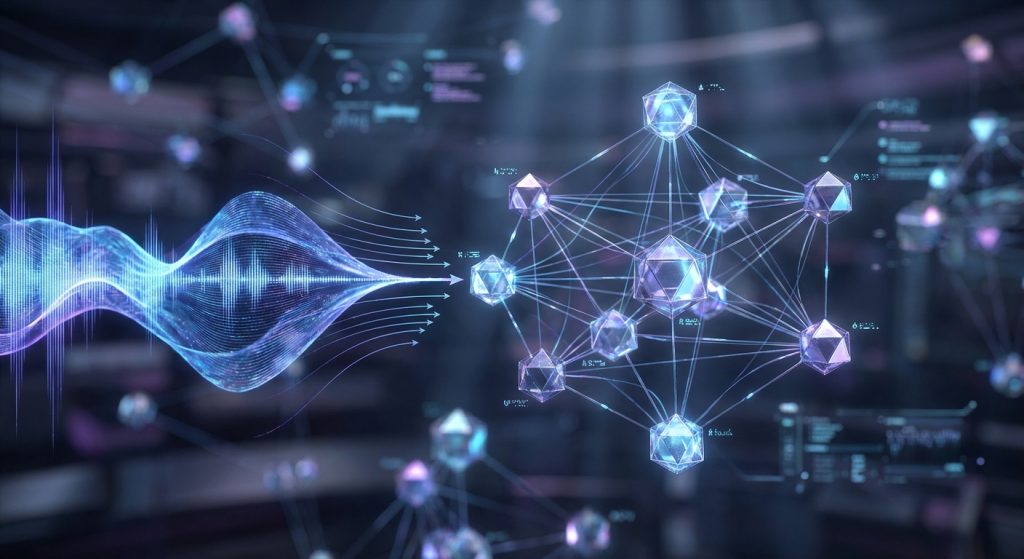
Imagine you have a complex audio waveform. Firstly, you slice this waveform into small, fixed-size chunks. Each chunk is then represented as a vector in a high-dimensional space. VQ works by creating a “codebook,” which is essentially a dictionary of prototype vectors.
For each audio chunk (vector), the system finds the closest matching vector in the codebook. Instead of storing the original, complex vector, it only stores the index of the codebook vector. Consequently, this dramatically reduces the amount of data needed to represent the audio signal. This process is a key part of reducing latency with audio token compression.
Why VQ is Crucial for Modern Synthesis
Modern audio synthesis, especially with neural networks, operates on discrete tokens. Raw audio waveforms are continuous and incredibly dense. VQ provides the bridge between these two worlds. It discretizes the continuous audio signal into a manageable sequence of tokens.
This tokenization is vital for models like transformers, which excel at processing sequences. In addition, VQ creates a compressed latent space. This space captures the essential features of the audio without the noise and redundancy. As a result, generative models can learn and synthesize audio more effectively within this structured environment.
Key Challenges in VQ for Audio
While powerful, VQ is not a perfect solution. Engineers often face several significant challenges when implementing it for high-fidelity audio synthesis. Overcoming these hurdles is key to unlocking the full potential of your models.
Codebook Collapse
One of the most common problems is codebook collapse. This occurs when the model learns to use only a small subset of the available vectors in the codebook. Many codebook entries become “dead” because they are never chosen as the closest match to any input vector.
This is highly inefficient. It means your model has a smaller expressive palette than intended. Consequently, the synthesized audio may lack variety and richness. For example, it might struggle to reproduce a wide range of timbres or subtle acoustic details.
Latency vs. Quality Trade-off
There is an inherent trade-off between compression (and thus latency) and audio quality. A smaller codebook leads to higher compression and lower latency. However, it also means each codebook vector must represent a larger, more diverse region of the feature space.
This can lead to a loss of detail, creating audible artifacts. Conversely, a very large codebook can capture fine details but increases computational load and memory usage. Finding the right balance is a central task for DSP engineers working on real-time synthesis applications.
Handling High-Frequency Detail
Human hearing is incredibly sensitive to high-frequency content. These details contribute to the “crispness” and “air” of an audio signal. Unfortunately, standard VQ can struggle to preserve these subtle components.
Because high-frequency details are often lower in amplitude than the main body of a sound, they can be lost during the quantization process. The model might prioritize matching the louder, lower-frequency parts of the signal, sacrificing the delicate high-end information. This results in audio that sounds muffled or dull.
Core Strategies for VQ Optimization
Fortunately, researchers have developed several powerful techniques to address the challenges of VQ. These strategies improve fidelity, prevent codebook collapse, and enhance the overall efficiency of the audio synthesis pipeline.
Residual Vector Quantization (RVQ)
Residual Vector Quantization, or RVQ, is a game-changer. Instead of using a single large codebook, RVQ uses multiple smaller codebooks in stages. This approach is highly effective.
Here’s how it works:
- The first VQ stage quantizes the original audio vector, leaving a “residual” error (the difference between the original and the quantized vector).
- The second VQ stage then quantizes this residual error, not the original signal.
- This process can be repeated for several stages. Each subsequent stage refines the approximation by correcting the errors of the previous one.
As a result, RVQ can achieve very high fidelity with a relatively small total number of codebook entries. It’s like painting a picture with broad strokes first, then adding finer and finer details with subsequent layers.
Multi-Stage and Hierarchical VQ
Building on the idea of RVQ, hierarchical VQ structures the quantization process. For instance, a model might first use a VQ layer to capture the coarse, overall structure of a sound. Then, subsequent layers can focus on adding finer textural details.
This approach allows the model to learn features at different time scales. For example, one layer might encode the general pitch contour, while another encodes the specific timbre or transient attack. This division of labor makes the learning process more stable and efficient.
Improving Codebook Learning
Preventing codebook collapse often requires specific training techniques. One popular method is to add a “commitment loss” to the training objective. This loss term encourages the audio encoder’s output to stay close to the chosen codebook vectors, making the codebook more relevant.
In addition, some methods use exponential moving averages (EMAs) to update the codebook vectors instead of relying on standard backpropagation. This can lead to a more stable learning process where the codebook evolves smoothly over time. Other techniques involve periodically resetting “dead” vectors to be closer to high-density areas of the input data, giving them a new chance to be learned.
Advanced Optimization Techniques
For state-of-the-art results, engineers can employ even more sophisticated methods. These advanced techniques push the boundaries of quality and efficiency in generative audio.
Jitter and Stochasticity
One clever trick is to add a small amount of “jitter” during training. This involves adding a tiny amount of noise to the encoder’s output before the quantization step. This small perturbation can help prevent the model from becoming too reliant on a few codebook entries, thus reducing collapse.
Stochastic quantization takes this a step further. Instead of always picking the single closest vector, it might sample from a few nearby vectors. This introduces randomness that can improve the model’s robustness and the naturalness of the synthesized audio.
Look-Ahead Encoding
In some architectures, the encoder can “look ahead” at future audio frames to make a better decision for the current frame. By having more context, the model can choose a codebook vector that not only represents the current moment but also ensures a smoother transition to the next. This can significantly reduce artifacts at the boundaries between quantized frames. Ultimately, this leads to a more coherent and pleasant listening experience.
Integrating with Generative Models
The true power of VQ is realized when combined with powerful generative models like VAEs (Variational Autoencoders) and GANs (Generative Adversarial Networks). A VQ-VAE, for example, learns to encode audio into a discrete latent space and then decode it back into a waveform.
The VQ layer forces the model to learn a compressed, meaningful representation. This is particularly useful for controlling synthesis. For instance, you can manipulate the sequence of codebook indices in the latent space to change the pitch, timbre, or rhythm of the generated audio. This level of control is essential for creative applications. Moreover, the process of quantization can significantly impact computational resources, making an understanding of reducing GPU memory via token quantization essential for deployment.
Frequently Asked Questions (FAQ)
What is the ideal codebook size for audio synthesis?
There is no single “ideal” size. It depends entirely on the application. For low-bitrate speech codecs, a smaller codebook (e.g., 128-256 vectors) might suffice. For high-fidelity music synthesis, you might use multiple codebooks with 512, 1024, or even more vectors each, especially when using techniques like RVQ. The best approach is to experiment and measure the impact on both audio quality and computational performance.
How does VQ differ from scalar quantization?
Scalar quantization quantizes each individual data point (sample) independently. In contrast, Vector Quantization groups multiple samples into a vector and quantizes the entire vector at once. Because VQ can exploit the correlations between samples within a vector, it is almost always more efficient and provides better quality at the same bitrate compared to scalar quantization.
Can VQ be used for tasks other than synthesis?
Absolutely. VQ is a fundamental technique in signal processing. It is widely used in audio and video compression (codecs), speech recognition (where it’s used to model phonetic sounds), and pattern recognition. Any application that requires efficient representation of high-dimensional data can potentially benefit from VQ.
What are the main signs of a poorly optimized VQ model?
The most obvious sign is poor audio quality, such as muffled sounds, strange metallic artifacts, or a general lack of detail. During training, you should monitor “codebook perplexity.” A low perplexity indicates that the model is using very few of its available codes, which is a clear sign of codebook collapse. High reconstruction error is another red flag, showing the model is failing to accurately represent the original audio.
Conclusion: A Path to Better Audio
Optimizing Vector Quantization is a critical skill for DSP engineers in the age of generative AI. It is a field of constant innovation. By understanding the core challenges and employing advanced strategies like RVQ, improved learning algorithms, and hierarchical structures, you can overcome common pitfalls.
Ultimately, a well-optimized VQ layer leads to models that are not only more efficient but also capable of producing stunningly realistic and expressive audio. The trade-offs between quality, latency, and complexity will always exist. However, with these techniques, you are well-equipped to navigate them and build the next generation of audio synthesis tools.
