
Streamline Multilingual Dubbing with Token Sync
Published on Tháng 1 24, 2026 by Admin
The Challenge: Why Traditional Dubbing Is Breaking
For decades, the dubbing process has remained largely unchanged. While effective, it carries significant overhead. These traditional methods struggle to keep up with the demand for rapid, global content distribution. Consequently, many localization teams face bottlenecks.
High Costs and Slow Timelines
The traditional dubbing workflow is complex and involves many manual steps. First, you need to find and cast voice actors for each language. Then, you must book expensive studio time for recording sessions. Finally, sound engineers spend countless hours editing and mixing the audio tracks.Each of these stages adds time and cost to your project. Coordinating these efforts across multiple languages creates even more complexity. This makes it incredibly difficult to launch content simultaneously in different regions.
The Elusive Perfect Lip-Sync
Achieving accurate lip-sync is one of the biggest challenges in dubbing. When the new audio does not match the on-screen actor’s lip movements, it creates a jarring experience for the viewer. This can significantly reduce the quality and impact of your content.Post-production teams work hard to align the audio. However, this manual process is painstaking and often imperfect. Different languages have different sentence structures and lengths, which makes a perfect match nearly impossible.
A New Era: AI-Powered Dubbing and Tokens
Artificial intelligence is fundamentally changing media production. AI-powered dubbing leverages machine learning models to automate and enhance the localization process. At the heart of this revolution is the concept of “tokens.”
What Are Tokens in Media AI?
In simple terms, tokens are small, manageable pieces of data. AI models break down complex information into these tokens to understand and process it. For instance:
- Audio tokens can represent phonemes, which are the smallest units of sound in a language.
- Text tokens can be words, parts of words, or characters.
- Video tokens can represent visual cues, such as the shape of a speaker’s lips at a specific moment.
By working with these granular tokens, AI can perform incredibly precise tasks.
How AI Generates Voice
Modern text-to-speech (TTS) and voice cloning technologies are powered by AI. These systems analyze vast amounts of audio data to learn the nuances of human speech. For example, they can replicate a specific person’s voice with stunning accuracy.The AI generates new speech by assembling audio tokens in a specific sequence. Moreover, it can control the pitch, pace, and emotional tone of the generated voice. This capability is crucial for creating dubs that sound natural and engaging. In fact, advanced techniques like semantic token mapping for lifelike voice generation are key to achieving this realism.
Introducing Token Sync: The Core of Modern Dubbing
While AI voice generation is powerful, its true potential is unlocked with Token Sync. This technology directly addresses the age-old problem of lip-sync in dubbing. It creates a seamless and natural viewing experience by precisely aligning audio and video.
How Token Sync Technology Works
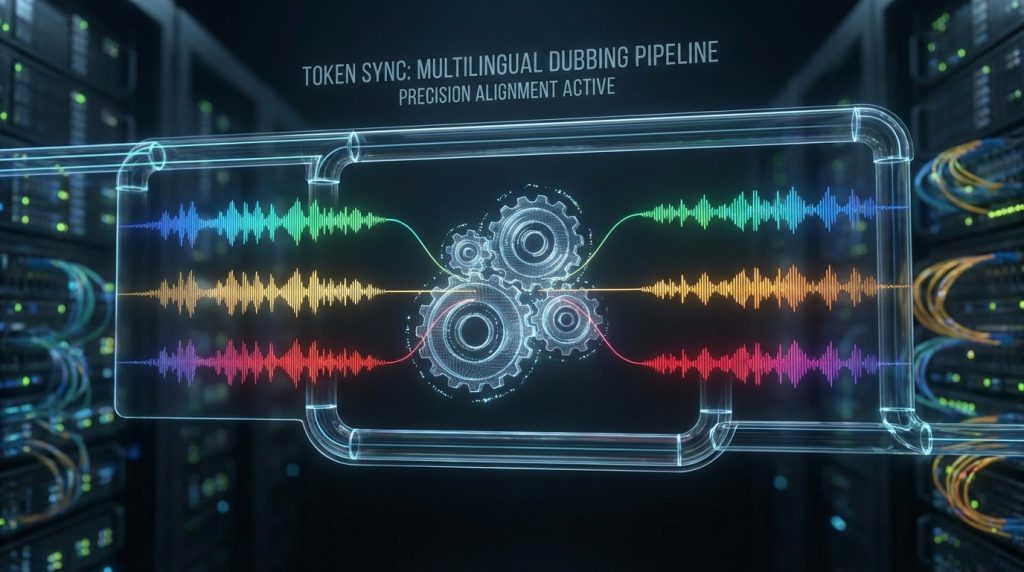
The Token Sync process is a sophisticated, multi-step workflow. Firstly, the AI analyzes the source video and audio. It identifies key video tokens (lip movements) and audio tokens (phonemes and timing).Next, the script is translated into the target language. The AI can then generate the new dialogue using a cloned or synthetic voice. This is where the magic happens. The Token Sync engine intelligently aligns the new audio tokens with the original video tokens. It adjusts the timing, adds or removes microscopic pauses, and ensures that the sounds match the on-screen lip movements.
The Key Difference: Precision Alignment
Traditional dubbing tries to fit a new performance into the timing of an old one. In contrast, Token Sync builds a new performance that is perfectly tailored to the existing video. Because the AI operates at the token level, it can achieve a level of precision that is impossible to replicate manually.This process involves more than just audio. It’s a holistic approach that considers both sound and picture simultaneously. Therefore, the technology is often referred to as cross-modal tokenization for better lip-syncing, as it connects data from different modes (audio and video).
Tangible Benefits for Localization Managers
Adopting a Token Sync workflow provides immediate and significant advantages for any localization team. These benefits directly impact your budget, timelines, and the final quality of your content.
Slash Turnaround Times and Costs
Token Sync automates the most time-consuming parts of the dubbing process. As a result, you can eliminate the need for lengthy studio sessions and manual audio editing. This dramatically reduces project turnaround times from weeks or months to just days or even hours.Furthermore, lower manual labor and studio costs translate directly into budget savings. This allows you to allocate resources to other strategic initiatives.
Achieve Unprecedented Scalability
Imagine dubbing a corporate training video into ten languages. With traditional methods, this would be a massive logistical undertaking. However, with Token Sync, the process is highly scalable.Because the workflow is software-based, you can run multiple languages in parallel. This enables you to reach a global audience faster and more consistently than ever before.
Enhance Viewer Experience with Better Sync
Ultimately, the goal of dubbing is to create an immersive experience for the viewer. Poor lip-sync can break this immersion. Token Sync delivers a superior final product with highly accurate synchronization.This enhanced quality ensures that your message resonates with international audiences. It also protects your brand’s reputation for producing high-quality content across all markets.
Implementing a Token Sync Workflow
Transitioning to an AI-powered dubbing workflow is more straightforward than you might think. It primarily involves choosing the right tools and preparing your source materials correctly.
Choosing the Right Technology Partner
Several platforms now offer AI dubbing services. When evaluating partners, look specifically for their Token Sync capabilities. Ask for demos and case studies that showcase their lip-sync accuracy. A good partner will provide a user-friendly platform and support to help you get started.
Preparing Your Content for AI Dubbing
To get the best results from any AI system, you need to provide high-quality input. For dubbing, this means:
- Clean Source Video: Use the highest resolution video available.
- Isolated Dialogue: Provide a clean audio track of the dialogue, separate from music and sound effects (a dialogue stem).
- Accurate Transcripts: A correct transcript of the original dialogue helps the AI with initial alignment.
By preparing these assets, you set your project up for success.
Frequently Asked Questions
Is AI dubbing as good as human voice actors?
AI dubbing technology is improving at an incredible pace. For many types of content, such as e-learning, corporate videos, and documentaries, AI voices are already on par with or even exceed the quality of non-professional voice actors. For high-end cinematic content, it is a powerful tool that works alongside human talent to improve efficiency.
How does Token Sync handle languages with different sentence lengths?
This is a key strength of the technology. The AI can work with linguists to adapt the translation for timing. In addition, the Token Sync engine can subtly compress or expand the generated speech and adjust pauses to fit the available time without sounding unnatural. This ensures the performance fits the scene perfectly.
Can I use a specific voice, like our CEO’s, for dubbing?
Yes. Most advanced AI dubbing platforms offer voice cloning services. With a short sample of high-quality audio, the AI can create a digital replica of a specific person’s voice. This is ideal for maintaining brand consistency in corporate communications.
What is the main advantage of Token Sync over just using AI text-to-speech?
Standard text-to-speech simply converts text into audio. Token Sync, on the other hand, is a comprehensive solution that synchronizes that generated audio with video. It aligns the sounds of the words (phonemes) with the lip movements on screen, which is something basic TTS cannot do.
Conclusion: The Future is Synchronized
The demand for localized content is only growing. Traditional dubbing methods, while valuable, cannot offer the speed, cost-efficiency, and scalability required in the modern media landscape. Consequently, Localization Managers must look for innovative solutions.Token Sync technology represents a paradigm shift in multilingual content production. By leveraging the power of AI to achieve perfect lip-sync, you can streamline workflows, reduce costs, and deliver a superior viewing experience. Therefore, embracing this technology is no longer just an option; it is a strategic necessity for global success.
