
Real-Time Cloud Billing Insights: A FinOps Imperative
Published on Tháng 1 14, 2026 by Admin

Understanding your cloud spending in real time is no longer a luxury. It’s a necessity for effective FinOps. This article explores why real-time cloud billing insights are crucial and how to achieve them.
Why Real-Time Cloud Billing Insights Matter
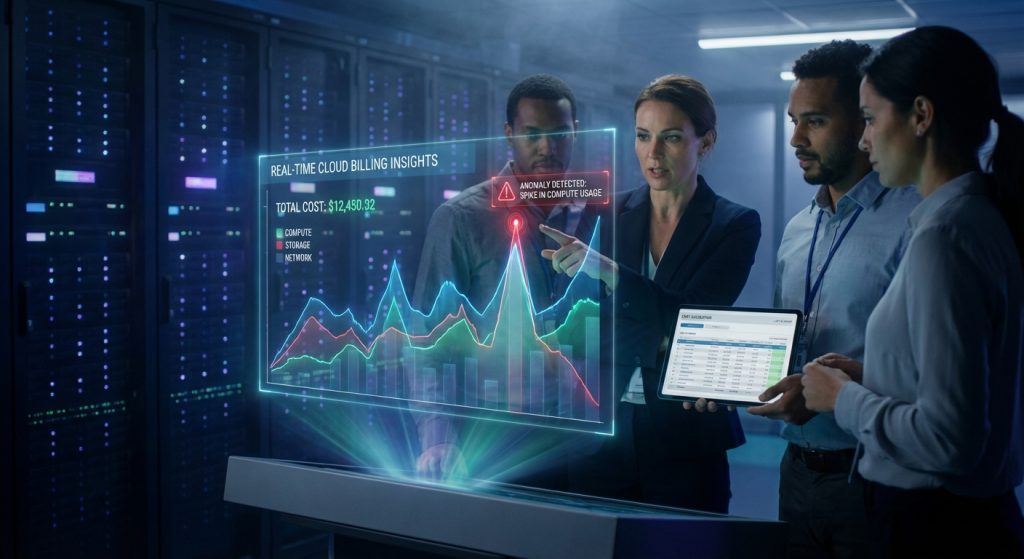
Cloud costs can escalate quickly. Without immediate visibility, you risk significant overspending. Real-time insights allow FinOps practitioners to spot anomalies and trends as they happen. This proactive approach is key to controlling costs. Moreover, it enables timely decision-making. For instance, you can immediately identify which projects or services are driving unexpected expenses. This prevents budget overruns. Therefore, real-time data is fundamental for a robust FinOps strategy.
The ability to see spending patterns as they emerge transforms cost management. Instead of reacting to monthly bills, you can intervene daily or even hourly. This agility is critical in dynamic cloud environments. Consequently, organizations gain better control over their financial commitments. This helps in optimizing resource allocation and maximizing value from cloud investments.
Key Components of Real-Time Billing Insights
Achieving real-time cloud billing insights involves several key components. Firstly, you need robust data ingestion. This means pulling billing data from all your cloud providers seamlessly. Secondly, data normalization and enrichment are vital. This process translates raw billing data into a format that business users can understand. It often involves adding business context, such as team ownership or project codes. Finally, powerful visualization and analysis tools are essential. These tools allow you to explore the data easily.
Google Cloud, for example, offers Cloud Billing Reports. These reports allow users to analyze billing data and cost trends. You can configure these reports with various settings and filters. This helps in answering critical questions about your spending. For example, you can track current month’s spending trends or identify which Google Cloud service costs the most. Accessing these reports requires appropriate permissions, such as Billing Account Viewer or Billing Account Costs Manager roles.
Leveraging Cloud Provider Tools
Major cloud providers offer built-in tools for cost management. Google Cloud’s Reports page is a prime example. It displays usage costs across all linked projects. You can customize the data range, time frame, and group data by project, service, SKU, or location. This granular control helps in pinpointing cost drivers. For instance, you can compare daily costs per service over time. Furthermore, you can forecast future costs based on historical trends. This proactive approach is essential for managing cloud expenditure effectively.
Similarly, other cloud platforms provide their own cost management dashboards. These often include features like cost allocation, budgeting, and anomaly detection. However, managing costs across multiple clouds can be complex. This is where unified platforms become invaluable.
The Role of FinOps Platforms
While cloud provider tools are useful, they often operate in silos. FinOps platforms offer a unified view across multiple cloud environments. DoiT’s Cloud Analytics is one such platform. It transforms billing data from AWS, Azure, and Google Cloud into a single source of truth. Importantly, it normalizes usage data and enriches it with business context. This makes it easy to explore costs from high-level trends down to line-item details. Therefore, teams can uncover cost drivers and tie spend to business goals more effectively.
These platforms go beyond basic reporting. They offer features like anomaly detection and commitment efficiency dashboards. For example, real-time anomaly investigation allows teams to catch unexpected spend changes fast. They can then drill down by service, SKU, or resource to understand the root cause. This immediate feedback loop is crucial for preventing cost surprises. Furthermore, seamless integration with existing tools like Grafana or Looker ensures data is accessible where teams work. This bridges the gap between data and action, which is a core tenet of effective FinOps.
Achieving Real-Time Data Synchronization
For true real-time insights, data synchronization is paramount. This often involves setting up continuous data pipelines. For instance, replicating operational data from sources like Oracle databases into data warehouses in real time is possible. Google Cloud’s Datastream, Dataflow, and BigQuery can be used together for this purpose. Datastream captures and replicates data. Dataflow processes and enriches it. Finally, BigQuery stores it for analytics and visualization. This enables timely, data-driven business decisions without inconvenient batch windows.
This process ensures that the data used for analysis is as fresh as possible. It minimizes the lag between a transaction occurring and it appearing in reporting tools. Consequently, FinOps teams can react to changes in near real time. This is especially important for dynamic workloads or rapidly scaling applications. For insights into scaling such systems, consider exploring the challenges and solutions in scaling Apache Druid for real-time cloud analytics.
Key Questions Answered by Real-Time Insights
Real-time cloud billing insights help answer critical questions that impact financial health. These include:
- How is my current month’s cloud spending trending?
- Which cloud project or service incurred the most cost recently?
- What are my forecasted future costs based on current trends?
- How do my daily costs per service compare over the last few days?
- What is the cost of resources associated with a specific label or tag?
- Are there any sudden, unexpected spikes in spending?
Answering these questions promptly allows for immediate cost optimization. For example, if a particular service shows a sharp increase in cost, the team can investigate. It might be due to increased usage, inefficient configurations, or even unauthorized resource provisioning. This rapid identification and remediation are hallmarks of advanced FinOps practices.
Permissions and Access Control
Accessing billing reports requires appropriate permissions. In Google Cloud, for instance, you need specific IAM roles on the billing account or project. For account-level reports, roles like Billing Account Viewer or Billing Account Costs Manager are necessary. These roles grant permissions like `billing.accounts.get` and `billing.accounts.getSpendingInformation`. For project-level reports, roles like Project Viewer or Project Editor are usually sufficient, granting permissions like `billing.resourceCosts.get`.
Proper access control ensures that only authorized personnel can view and manage cost data. This is crucial for maintaining data security and preventing misuse. It also helps in aligning responsibilities within the FinOps team. For a deeper understanding of how these principles apply in practice, exploring Shared Responsibility Models & FinOps can provide valuable context.
Forecasting and Trend Analysis
Beyond just viewing current spending, real-time insights enable powerful forecasting. By analyzing historical data and current trends, you can predict future cloud expenses. This is invaluable for budgeting and financial planning. For instance, if you see a consistent upward trend in a specific service’s cost, you can forecast its impact on the next quarter’s budget. This allows for proactive adjustments, such as optimizing resource usage or exploring cost-saving alternatives.
This forecasting capability is a significant advantage over traditional, retrospective billing analysis. It shifts the focus from simply reporting past spend to actively managing future spend. This forward-looking perspective is essential for modern financial operations. It also aligns with the broader FinOps goal of maximizing business value from cloud investments.
Real-Time Payments vs. Real-Time Billing
It’s important to distinguish real-time billing insights from real-time payments. While both leverage real-time data, their objectives differ. Real-time payments, as discussed in reports like ACI Worldwide’s Prime Time for Real-Time Global Payments Report, focus on the rapid movement of funds between parties. This can involve instant transaction volumes and forecasts across various markets. These systems are designed for financial transactions. On the other hand, real-time cloud billing insights are about understanding and managing the costs associated with cloud infrastructure and services. The goal is financial governance, not payment processing.
Although their functions are distinct, both highlight the growing importance of real-time data across various business domains. The underlying technology and the demand for immediate information are common themes. Both require robust data pipelines and analytical capabilities to be effective.
Conclusion: Embracing Real-Time FinOps
In conclusion, real-time cloud billing insights are indispensable for any organization serious about FinOps. They provide the visibility and agility needed to control cloud spend effectively. By leveraging cloud provider tools, specialized FinOps platforms, and robust data synchronization strategies, businesses can gain immediate clarity into their cloud costs. This empowers teams to make informed decisions, optimize resource utilization, and ultimately drive greater value from their cloud investments. Therefore, embracing real-time insights is a critical step toward achieving financial accountability and operational excellence in the cloud.
Frequently Asked Questions
What are the minimum permissions needed to view Google Cloud billing reports?
To view all costs for a Google Cloud Billing account, you need roles on the billing account that include the `billing.accounts.get` and `billing.accounts.getSpendingInformation` permissions. Predefined roles like Billing Account Viewer, Billing Account Costs Manager, or Billing Account Administrator typically grant these. For project-level reports, you need roles on the Google Cloud project that include `billing.resourceCosts.get` and `resourcemanager.projects.get` permissions, such as Project Viewer or Project Editor.
How can I get real-time insights if my data is in an Oracle database?
You can achieve real-time insights by replicating data from your Oracle database into a data warehouse like Google Cloud’s BigQuery. Tools like Datastream can capture and replicate data, Dataflow can process and enrich it, and BigQuery can store it for analysis. This process allows for timely, data-driven business decisions.
Are real-time payments and real-time billing insights the same thing?
No, they are different. Real-time payments focus on the swift transfer of funds between parties, while real-time billing insights focus on providing immediate visibility into cloud infrastructure and service costs for financial management and optimization.
What is the benefit of using a dedicated FinOps platform over native cloud tools?
Dedicated FinOps platforms offer a unified view across multiple cloud providers (AWS, Azure, GCP), normalizing and enriching data with business context. They often provide more advanced features like cross-cloud anomaly detection and commitment management dashboards, which native tools may lack when managing multi-cloud environments. This holistic approach simplifies cost governance and empowers teams with a single source of truth.
How do real-time insights help in forecasting cloud costs?
Real-time insights allow for continuous analysis of current spending patterns. By feeding this up-to-the-minute data into forecasting models, you can generate more accurate predictions of future cloud expenses. This enables proactive budgeting and resource planning, helping to avoid unexpected cost overruns.
