
Optimize Hiring to Offboarding: The Workforce Value Stream
Published on Tháng 1 7, 2026 by Admin
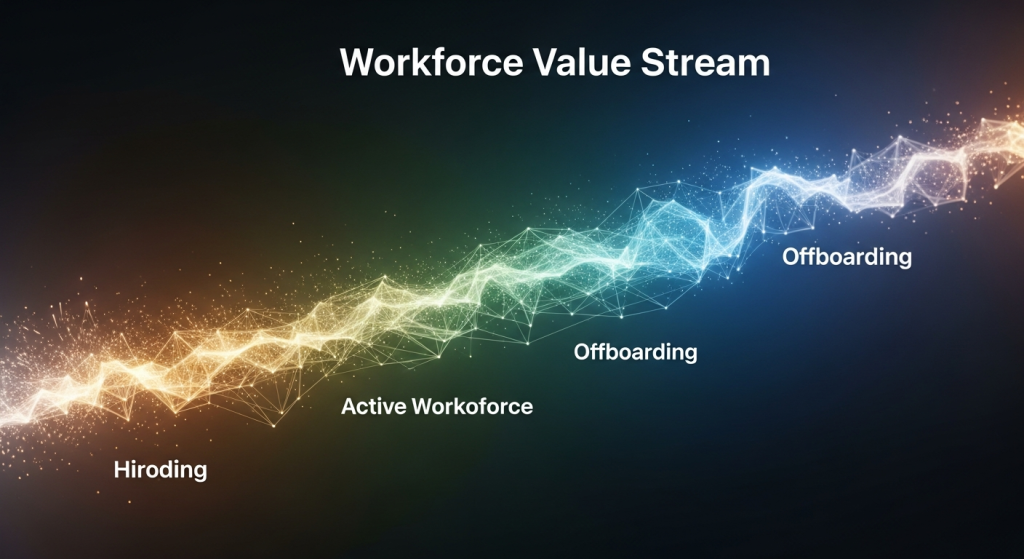
As a Lean Six Sigma Black Belt, you master the art of optimizing value streams. You relentlessly hunt for waste, streamline processes, and drive efficiency. However, many practitioners focus exclusively on production or service delivery. They often overlook one of the most critical value streams in any organization: the workforce.
The Workforce Value Stream, also known as the Employee Value Stream (EVS), is a powerful concept. It reframes the entire employee lifecycle—from hiring to offboarding—as a process designed to deliver value. Consequently, by applying your Black Belt skills here, you can unlock profound improvements in performance, satisfaction, and overall business results.
This guide will walk you through the concept of the Workforce Value Stream. Moreover, we will explore its core processes and show you how to apply familiar Lean tools to optimize it for maximum impact.
What is a Workforce Value Stream?
First, let’s start with a familiar definition. A value stream is the sequence of activities necessary to deliver a product, service or experience to a customer. Its roots are in lean manufacturing, specifically the Toyota Production System, which aims to shorten time-to-value.
Now, let’s apply this to your people. The Employee Value Stream (EVS) is a series of business processes that starts with planning a new hire and concludes with that employee’s departure. The “customer” of this value stream is the business unit that the employee serves. The “product” is a satisfied, effective, and high-performing employee who fulfills a corporate need throughout their tenure.
Therefore, thinking in these terms moves HR functions from isolated silos into an interconnected, manageable system. It’s not just about filling roles; it’s about creating a smooth, efficient flow that develops and retains top talent.

The 10 Core Processes of the Employee Value Stream
According to research, the EVS typically contains between 8 and 12 core business processes. Understanding each step is the first part of seeing the whole system. Here are 10 common processes that comprise the stream.
1. Workforce Planning
This is the starting point of the value stream. It involves developing the company’s staffing and recruiting requirements. In this stage, poor planning can introduce significant waste later, such as panic-hiring or creating roles that don’t align with strategic goals.
2. Recruiting
Next, the recruiting process aims to deliver qualified candidates who are ready to receive an offer. Black Belts can analyze this process for bottlenecks. For example, where do candidates drop out? How long does each stage take? A focus on Data-Driven Hiring: A Guide to Smarter Recruiting can significantly improve the quality of inputs for the next stage.
3. Hiring
The hiring stage delivers candidate offers and negotiates terms. It ends with a decision to hire or not. Delays here can cause you to lose top candidates. Furthermore, a lack of standardization can lead to inconsistencies in compensation and terms.
4. On-Boarding
On-boarding sets up and assimilates new employees into the company. A poor onboarding experience is a major source of waste. For instance, it can lead to early dissatisfaction, low productivity, and a higher chance of turnover. This process must be smooth and effective.
5. Compensation
This process ensures employees’ compensation is administered accurately and on time. Errors here directly impact employee satisfaction and trust. Therefore, it must be a highly reliable and transparent process.
6. Benefits
The benefits process educates, enrolls, and administers employee insurance and other benefits. Complexity and lack of clarity are common pain points. As a result, simplifying this process can greatly enhance the employee experience.
7. Performance Management
This is a critical feedback loop. It provides the knowledge, direction, and measurement needed to maintain high-performing employees. A well-designed performance management system aligns individual efforts with company objectives and provides clear paths for growth.
8. Succession Planning
This process develops a plan for replacing key leadership and management positions. Without it, the organization is exposed to significant risk when a key employee leaves. It is an essential part of long-term stability.
9. Development
The development process aims to grow an employee’s capabilities throughout their career. Investing in employee growth is a direct investment in the company’s human capital. Moreover, a strong program for Upskilling for Peak Efficiency: An L&D Leader’s Guide is crucial for retaining top talent and adapting to market changes.
10. Off-Boarding
Finally, the off-boarding process handles an employee’s departure. A smooth and respectful off-boarding process can provide valuable feedback through exit interviews. It also protects the company’s brand and can even lead to “boomerang” employees returning in the future.
Why Black Belts Must Master the Workforce Value Stream
Applying Lean Six Sigma to the EVS offers tremendous advantages. It allows you to move beyond task-level improvements and optimize the entire system for delivering value.
As one analysis states, “While improving a task is good, improving a process is better, and improving the total value stream will yield the best overall results.” This mindset is the essence of a Black Belt’s work.
By managing the EVS, you connect high-level business strategy with the teams on the ground. This breaks down the silos that often exist between HR, finance, and operations. As a result, everyone becomes aligned around the ultimate goal: developing and retaining a high-performing workforce that delights the business units they serve.
How to Analyze and Improve Your Workforce Value Stream
You can use familiar Lean tools to diagnose and enhance your EVS. The most powerful starting point is Value Stream Mapping (VSM).
Start with Value Stream Mapping (VSM)
VSM is a technique to visualize work and understand how it flows. To map your EVS, you must gather stakeholders from every part of the stream. This includes HR, recruiters, hiring managers, IT (for onboarding tech), and finance (for compensation).
Together, you will break the value stream into its core process blocks, like the 10 listed above. The goal is to document the process as it *really* is today, not how it’s supposed to be.
Key Metrics for Your Workforce Value Stream Map
To identify barriers to flow, you need to measure what’s happening. The DORA research group suggests key metrics that can be adapted for the EVS.
- Lead Time: This is the total time from when a new hire is approved to when they are fully onboarded and productive. Long lead times can mean lost productivity for the business unit.
- Process Time: This measures the time it takes to complete a single item if you could work uninterrupted. For example, how long does an interview *actually* take versus how long it’s scheduled for? The gap between Lead Time and Process Time often reveals significant waiting and waste.
- Percent Complete and Accurate (%C/A): This is a crucial metric. It measures the quality of handoffs between processes. In an EVS, a low %C/A might mean a hiring manager receives candidates who don’t meet the job description, or a new hire arrives on day one without a laptop. This downstream rework is a major source of waste.
Visualizing the Flow
Once you have your map, you need ongoing visibility. A simple Kanban board can be used to track candidates through the recruiting and hiring pipeline. This visual management makes bottlenecks immediately obvious. For example, if the “Hiring Manager Interview” column is always full, you know exactly where the constraint is.
Common Pitfalls and How to Avoid Them
Implementing this requires navigating some common challenges. Awareness is the first step to overcoming them.
First, organizations often overestimate their knowledge. The reality is that nobody has a complete view of the entire value stream. That is why bringing a cross-functional team together for VSM is non-negotiable.
Second, watch out for silo-centric behavior. A recruiting team might be incentivized to reduce “time-to-fill.” However, if they do this by sending unqualified candidates to managers, they are simply pushing waste downstream. The goal is to optimize the whole stream, not just one part.
Frequently Asked Questions (FAQ)
What’s the difference between a Workforce Value Stream and just HR processes?
The key difference is perspective. Traditional HR often looks at processes like recruiting or performance management in isolation. The Workforce Value Stream, on the other hand, views them as an interconnected system designed to deliver a specific value: a high-performing employee. It focuses on the flow, handoffs, and overall efficiency of the entire system.
Can we use VSM for a new process, like a new onboarding program?
Absolutely. While VSM is often used to document an existing (“current-state”) process, it is also an excellent tool for designing a new one. This is called “future-state value stream mapping.” It allows you to proactively design a process that is lean and efficient from the start, rather than fixing a broken one later.
Who “owns” the Workforce Value Stream?
No single person or department owns it. It is a cross-functional responsibility. While an HR leader or a Black Belt might facilitate its management, ownership is shared. Stakeholders include business unit leaders (the “customers”), finance, IT, and the employees themselves. Success depends on collaboration across these groups.
What tools can help manage this?
While you can start with whiteboards and sticky notes, many enterprise platforms are incorporating this thinking. For example, strategic planning tools like ServiceNow now offer a “value stream lens” to connect portfolio plans directly to value streams. This shows a trend toward integrating these concepts into core business management systems.
Conclusion: Your Next Frontier for Optimization
For Lean Six Sigma Black Belts, the Workforce Value Stream represents a massive opportunity. It takes your proven skills for process optimization and applies them to the heart of the organization—its people.
By mapping, measuring, and improving the flow of value from workforce planning to off-boarding, you can drive significant change. You can break down departmental silos, align people operations with business strategy, and create a more engaged and effective workforce.
Ultimately, this approach yields the best overall results. It transforms HR from a cost center into a strategic value-creation engine, and that is a challenge worthy of any Black Belt.
