
How to Measure Workforce Agility: A Guide for Consultants
Published on Tháng 1 7, 2026 by Admin

In today’s volatile business landscape, organizations face constant change. Markets shift, customer expectations soar, and new technologies emerge at a dizzying pace. As a result, the ability to adapt is no longer a luxury; it is a core requirement for survival and success. This is where workforce agility becomes a critical strategic asset.
However, for many leaders, workforce agility remains a vague buzzword. This article provides a clear, actionable framework for strategy consultants. We will define workforce agility, explain why it’s crucial, and, most importantly, introduce a robust model for measuring it. With these metrics, you can help clients transform their teams from reactive responders into proactive, adaptable forces for growth.
What is Workforce Agility (And Why Does It Matter Now)?
Workforce agility is the ability of your people to shift quickly and adapt to change without losing productivity or engagement. It’s about how teams on the ground execute and keep things moving when priorities change. This is different from business agility, which focuses more on high-level organizational strategy. Workforce agility is the engine that powers that strategy.
The need for this capability is more urgent than ever. A recent Lighthouse Research & Advisory report revealed a startling gap: 63% of executives believe their workforce is unprepared for change. This readiness gap poses a significant risk to performance and competitiveness.
Fostering an agile workforce delivers tangible results across the organization. Key benefits include:
- Increased Productivity: Agile teams use resources more effectively. Cross-skilling and flexible tasking mean work doesn’t stall when priorities shift or a key person is unavailable.
- Higher Employee Engagement: Agility empowers employees with more autonomy, variety, and growth opportunities. This directly impacts motivation and retention.
- Better Customer Satisfaction: Agile frontline teams can solve customer problems on the spot and respond to feedback quickly, leading to better service.
- Enhanced Innovation: Empowered employees who are close to the customer can identify problems and test solutions, turning daily insights into real innovation.
- Talent Attraction: Today’s top talent seeks flexibility and development. An agile culture is a powerful magnet for attracting and retaining these individuals.
The Problem with Vague Agility Models
Despite its importance, workforce agility has often been difficult to measure. Historically, the concept has been studied in a limited and unsystematic way. Many early models and measures were criticized for being conceptually vague and lacking empirical validation.
For instance, some popular frameworks did not show a good model fit in academic studies, meaning they weren’t reliable predictors of actual agile behavior. This lack of a clear, validated measurement system has made it difficult for organizations to assess their capabilities, identify gaps, and track progress over time.
Without solid metrics, workforce agility initiatives risk becoming exercises in frustration. Therefore, moving beyond these vague descriptions is fundamental to making real progress.
A 10-Factor Framework for Measuring Workforce Agility
To address these gaps, researchers Moritz Petermann and Hannes Zacher developed and validated a multidimensional measure for workforce agility. Their work, published in *Frontiers in Psychology*, provides a robust, 10-factor model that consultants can use to assess and develop client workforces. This framework moves beyond simple definitions to provide concrete, measurable dimensions.
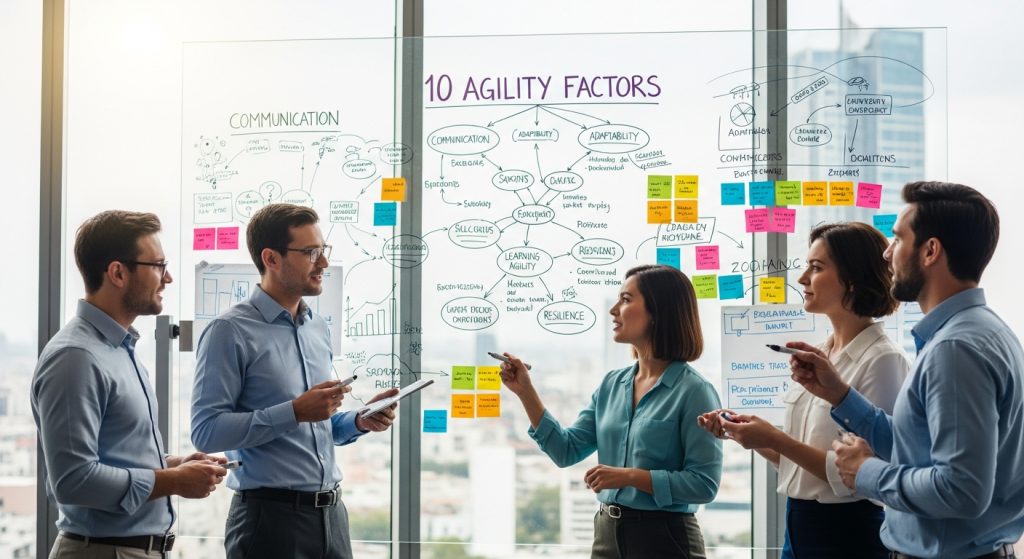
These ten dimensions can be grouped into three key areas: foundational mindsets, collaborative practices, and iterative processes.
Foundational Mindsets & Behaviors
These factors form the cultural bedrock of an agile workforce. They relate to how individuals perceive and approach their work and the changing environment.
- 1. Accept Changes: This is the willingness of employees to embrace new situations, processes, and structures rather than resisting them. It’s a proactive mindset toward change.
- 2. Learning: This dimension measures the drive to continuously acquire new skills and knowledge. Agile employees are curious and see learning as an integral part of their job.
Collaborative & Customer-Focused Practices
Agility is not an individual sport. These dimensions focus on how people work together and orient their efforts toward creating value for the end-user.
- 3. Collaboration: This involves working effectively across teams and departments, sharing information freely, and supporting colleagues to achieve common goals.
- 4. User Centricity: This is the practice of keeping the customer or end-user at the heart of all decisions. It involves actively seeking user feedback and using it to guide work.
- 5. Create Transparency: This means making information about goals, progress, and challenges widely accessible. Transparency builds trust and enables better decision-making at all levels.
Action-Oriented & Iterative Processes
These factors define the “how” of an agile workforce. They describe the dynamic, cyclical processes that enable teams to move fast, learn from mistakes, and adapt their approach.
- 6. Decision Making: This refers to the ability to make timely and effective decisions, often with incomplete information. In agile settings, decision-making is often decentralized.
- 7. Self-Organization: This is the capacity of teams to manage their own work, determine their own processes, and take ownership of their outcomes without constant top-down direction.
- 8. Iteration: This dimension involves working in short, repeatable cycles. Instead of a single “big bang” delivery, teams produce work incrementally, allowing for regular feedback and course correction.
- 9. Testing: This is the commitment to continuously test assumptions, prototypes, and products. It creates a feedback loop that reduces risk and improves quality.
- 10. Reflection: This practice involves regularly pausing to reflect on what is working and what is not. Teams use these insights to adapt and improve their processes for the next cycle.
How to Turn Metrics into Strategic Advantage
Measuring these ten factors is only the first step. The true value for your clients comes from using this data to drive strategic change. By assessing their workforce against this framework, you can help them pinpoint specific areas for improvement.
For example, a low score on “Collaboration” might indicate a need for better communication tools or cross-functional team-building initiatives. Similarly, a poor score in “Learning” highlights the high cost of skill gaps and points to the need for more targeted training and development programs. In fact, research shows that 94% of business leaders agree that their learning technologies play a significant role in boosting agility.
Moreover, these metrics allow you to connect HR and L&D initiatives directly to business outcomes. By tracking improvements in agility alongside performance data, you can demonstrate a clear return on investment for training programs, technology rollouts, and cultural change efforts. This data-driven approach strengthens the business case for investing in people.
The Tangible Outcomes of an Agile Workforce
Investing in workforce agility is not just about feeling more prepared. Empirical research confirms that it leads to significant, positive outcomes for both the organization and its employees.
The Petermann and Zacher study found that higher levels of workforce agility were positively related to:
- Task and Innovative Performance: Agile employees are not only better at their core tasks but also contribute more to innovation.
- Organizational Citizenship Behavior: They are more likely to go above and beyond their formal job duties to help colleagues and the company.
- Job Satisfaction and Well-being: Agility is linked to happier, less-stressed employees. This has a direct impact on retention and exploring the true ROI of employee wellbeing becomes a strategic priority.
These findings are supported by industry data. For example, a Deloitte study cited by Axonify found that giving frontline workers the right tools and training can boost productivity by up to 22%. Ultimately, an agile workforce is more productive, more innovative, and more resilient.
Frequently Asked Questions
What’s the difference between workforce agility and business agility?
Workforce agility is about execution—how people and teams adapt on the ground to keep work moving. Business agility, on the other hand, is about high-level organizational strategy—how the entire company adapts its structure, processes, and goals to thrive in a changing market. Workforce agility is the operational capability that enables business agility.
How do you start measuring workforce agility?
The best way to start is by using a validated, multidimensional framework like the 10-factor model. Avoid creating metrics from scratch, as they may not be reliable. Instead, use surveys and assessments based on this empirically tested model to create a baseline. This gives you a clear and accurate picture of your client’s current capabilities.
Is workforce agility only for tech teams?
Absolutely not. While the concept has roots in agile software development, it is now essential for all parts of the business. It is especially critical for frontline industries like retail, logistics, and manufacturing, where workers face constant change from new technology, shifting customer demands, and unpredictable schedules.
What are the biggest risks of ignoring workforce agility?
Ignoring workforce agility creates a “readiness gap” that leaves an organization vulnerable. The biggest risks include falling behind more adaptable competitors, suffering from lower productivity and innovation, experiencing higher employee turnover due to poor engagement, and being unable to respond effectively to sudden market shifts or crises.
