
FinOps Maturity Model: A Guide from Crawl, Walk to Run
Published on Tháng 1 6, 2026 by Admin

As cloud adoption accelerates, so does the complexity of managing its costs. Many Digital Transformation Leads face a common challenge: cloud spending grows without clear control or alignment to business goals. This situation often leads to reactive, stressful “why did our bill spike?” conversations. Fortunately, there’s a structured path forward.
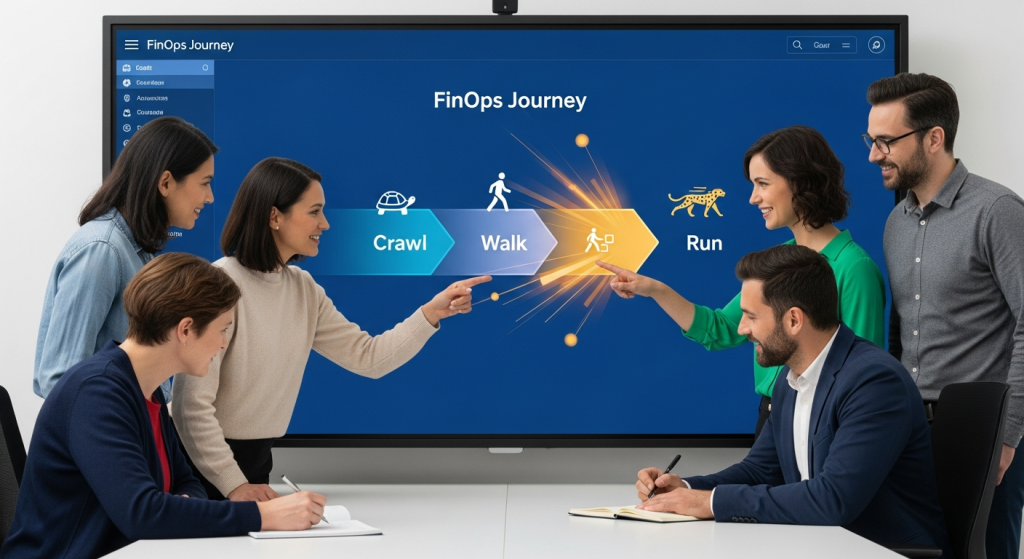
The FinOps Maturity Model provides a clear framework for organizations to assess and improve their cloud financial management. It outlines an iterative journey through three stages: Crawl, Walk, and Run. This model helps you move from basic cost tracking to strategic, value-driven cloud investment, ensuring every dollar spent supports your business objectives.
This guide will break down each stage, helping you identify where you are and how to advance your FinOps practice effectively.
What is the FinOps Maturity Model?
The FinOps Maturity Model is a guide that helps you understand and improve how you manage cloud costs. Think of it as a roadmap for your organization’s cloud financial journey. It takes you from the initial stages of simply tracking expenses to mastering complex, automated cost optimization strategies.
This model is not a rigid set of rules. Instead, it provides a structured approach to grow your FinOps capabilities. The FinOps Foundation proposes an iterative “Crawl, Walk, Run” progression. This method allows you to start small and grow in scale, scope, and complexity as your business needs evolve. Ultimately, the goal is to align IT spending with strategic business outcomes.
The Core Principle: Value Over Perfection
A critical concept to grasp is that your goal should not be to achieve the “Run” stage in every single FinOps capability. The model’s guiding principle is that business value should drive your decisions.
For instance, if your anomaly detection process is at a “Walk” stage and it effectively catches the few cost spikes you experience, that’s a success. Spending significant resources to push it to “Run” might provide no additional business benefit. Therefore, that effort is better invested in maturing another capability that could deliver an immediate, higher return. Prioritize maturing the areas that provide your organization the most value.
The Three Stages of FinOps Maturity
Your FinOps practice is a collection of different capabilities, such as cost allocation, forecasting, and optimization. Each of these can be at a different level of maturity. You might be “Running” with your tagging governance but still “Crawling” with anomaly detection. Understanding each stage helps you set realistic goals.
Stage 1: Crawl – Gaining Basic Visibility
The “Crawl” stage is the starting point. Here, your organization is just beginning to get a handle on its cloud costs. Actions are often reactive, typically triggered after an unexpectedly high cloud bill arrives. The primary focus is simply to find out where the money is going.
Characteristics of the Crawl stage include:
- Very little reporting and tooling.
- Processes are manual and not consistently followed.
- Cost allocation is basic or incomplete.
- There is a general lack of visibility into cloud spending.
In this phase, you might see a forecast accuracy variance of around 20%. A key goal is to achieve at least 50% cost allocation to teams or projects. A strong cloud tagging for cost governance strategy is fundamental to moving beyond this stage. In a Kubernetes environment, for example, this could involve using open-source tools to establish a baseline for resource requests and limits.
Stage 2: Walk – Proactive Cost Optimization
In the “Walk” stage, your organization moves from being reactive to proactive. FinOps processes are now understood and followed by the core teams. You’re no longer just watching costs; you are actively working to optimize them.
Key aspects of the Walk stage involve:
- More advanced tagging and allocation strategies are in place.
- Teams regularly review and optimize cloud resources.
- Some automation is used to cover most capability requirements.
- Governance policies for cloud usage are established and followed.
At this level, you should be able to allocate at least 80% of your cloud spend. Furthermore, your forecast-to-actual variance should tighten to around 15%. For Kubernetes users, this stage means moving beyond basic tools to a platform that provides visibility across multiple clusters, making it easier to identify opportunities for Kubernetes waste reduction and align engineering efforts with financial goals.
Stage 3: Run – Continuous Improvement & Automation
The “Run” stage represents a high level of FinOps maturity. Here, FinOps is deeply embedded in the organization’s culture and workflows. Automation is the preferred approach for managing and optimizing cloud costs, freeing up your team to focus on strategic initiatives.
Characteristics of the Run stage are:
- FinOps practices are understood and followed by all teams.
- Automation is the default for optimization, reporting, and governance.
- Forecasting models are sophisticated and highly accurate.
- FinOps is integrated directly into DevOps workflows (CI/CD).
In this mature phase, organizations aim for greater than 90% cost allocation and a forecast variance of 12% or less. Collaboration between finance, IT, and business units is seamless. Cloud financial data is not just for cost control; it’s used to drive strategic business decisions and innovation.
How to Implement the FinOps Maturity Model
Advancing through the stages requires a deliberate and strategic approach. It’s an ongoing cycle of assessment, planning, and execution.
Assess Your Current State
The first step is to honestly evaluate where you stand. Use the characteristics and KPIs of the Crawl, Walk, and Run stages as a rubric. Assess each FinOps capability—like visibility, optimization, and forecasting—independently. This assessment will highlight your strengths and reveal the areas that need the most attention.
Set Goals and Create a Roadmap
Once you know your current state, you can set realistic goals for improvement. Based on your assessment, create a detailed roadmap. Remember to prioritize based on business value. For example, if poor cost allocation is causing major friction between departments, focus on moving that capability from “Crawl” to “Walk” first.
Overcome Common Challenges
Implementing this model is not without its hurdles. Common challenges include resistance to cultural change, a lack of in-house FinOps expertise, and poor data quality from inconsistent tagging.
Addressing these requires clear communication about the benefits of FinOps. In addition, you should invest in training for your teams or consider partnering with consultants. Finally, establishing robust data management and tagging practices is crucial for building a solid foundation.
Frequently Asked Questions (FAQs)
What is the primary purpose of the FinOps Maturity Model?
The primary purpose is to provide a structured framework for organizations to systematically assess, implement, and optimize their cloud financial management practices. It helps align cloud spending with business objectives and drives a culture of financial accountability.
Do we need to reach the ‘Run’ stage for everything?
No, and this is a key point. The goal is not to achieve “Run” maturity for every capability. Instead, you should focus on maturing the capabilities that provide the highest business value to your organization. If a “Walk” level process is sufficient and effective, your resources may be better spent improving another area.
How do you measure success with the model?
Success is measured by tracking key performance indicators (KPIs) and, more importantly, business outcomes. Key metrics include cost savings, resource utilization rates, and forecast accuracy. However, the ultimate measure of success is the degree to which your cloud investments are efficiently driving business value and innovation.
