
Mastering Departmental Costs: A KPI-Driven Approach
Published on Tháng 12 24, 2025 by Admin
Department heads and controllers face a constant challenge: managing costs effectively. This requires more than just tracking expenses. It demands a strategic approach to understand performance and drive efficiency. Implementing Key Performance Indicators (KPIs) for cost control offers a powerful solution. Therefore, this article will guide you through this essential process.
Firstly, let’s understand what KPIs are. They are quantifiable measures. They help track progress towards strategic goals. For cost control, KPIs illuminate where money is spent and how effectively. Without them, departments might operate blindly, missing opportunities for savings. This can lead to budget overruns and reduced profitability.
The Foundation: Understanding KPIs for Cost Control
Key Performance Indicators (KPIs) are vital metrics. They measure an organization’s success in achieving specific goals. When applied to departmental cost control, KPIs provide a clear, data-driven view of financial performance. They act as a compass, guiding your department towards fiscal responsibility. In essence, they tell you what you want to achieve and how you will measure that achievement.
A good KPI is specific and measurable. It aligns with your department’s strategic objectives. For instance, instead of a vague goal like “reduce spending,” a KPI might be “decrease departmental operational expenses by 10% in the next fiscal quarter.” This specificity makes tracking and action easier. Good plans often utilize 5-7 KPIs to manage progress effectively.
Moreover, KPIs create a holistic picture of performance. They highlight outputs and measure progress against targets. They are the heartbeat of any performance management system. Therefore, selecting the right KPIs is crucial for successful cost control.
Why KPIs Matter for Cost Management
The benefits of using KPIs for cost control are numerous. They provide clarity and focus. This helps align your team’s efforts with departmental objectives. You can see measurable progress over time. This fosters a culture of continuous improvement.
Furthermore, KPIs facilitate communication. They create a shared understanding of success across your department. When everyone understands the key metrics, they can work more cohesively towards common financial goals. This transparency is invaluable.
Crucially, KPIs enable proactive decision-making. By monitoring key financial indicators, you can identify potential issues before they become major problems. This allows for timely interventions and prevents costly surprises. For example, tracking budget adherence can flag overspending early. This allows for corrective actions before the quarter ends.
KPIs also drive accountability. Assigning ownership for specific KPIs ensures someone is responsible for tracking, reporting, and improving them. This fosters a sense of responsibility within the team. Ultimately, this leads to better financial stewardship.
Defining Your Departmental Cost KPIs
To implement effective KPI-based monitoring, you must first identify relevant KPIs. The selection process should align with your department’s specific goals and the organization’s overall strategy. Consider the unique cost drivers within your department. What aspects of spending have the most significant impact?
Source 3 highlights that KPIs can be categorized. This helps in a structured approach. For cost control, relevant categories include financial performance, operational efficiency, and risk management. Each category offers specific metrics to monitor.
Essential KPI Categories for Cost Control
- Financial Performance KPIs: These directly measure the financial health and success of your spending. They offer insights into profitability and cost-effectiveness.
- Operational Efficiency KPIs: These focus on how efficiently resources are used. They often reveal bottlenecks that lead to increased costs.
- Risk Management KPIs: These help identify potential financial risks associated with spending and contracts. Early detection can prevent significant losses.
- Vendor/Supplier Performance KPIs: Monitoring third-party costs and performance is crucial. Poor vendor performance can lead to unexpected expenses.
For instance, within financial performance, metrics like ‘Total Cost Management’ and ‘Budget Adherence’ are critical. Operational efficiency might include ‘Cost per Unit’ or ‘Process Cycle Time.’ Risk management could involve ‘Contract Compliance Rate.’ Vendor performance might track ‘On-Time Delivery Rate’ or ‘Invoice Accuracy.’
Source 4 provides a comprehensive list of financial KPIs. Metrics like ‘Gross Profit Margin,’ ‘Net Profit Margin,’ and ‘Total Cost Management’ are essential. They help understand the fiscal health of your operations. Budget adherence, for example, compares actual expenses to budgeted amounts. This helps identify deviations and improve future budgeting accuracy.
Remember, the goal is to select a manageable number of KPIs. Typically, 5-7 well-chosen KPIs are more effective than a large, overwhelming list. Each KPI should have a clear measure, a defined target, and a specific data source.
Establishing Your KPI Framework: The Five Essential Elements
A robust KPI framework is the backbone of effective monitoring. Each KPI needs to be clearly defined with specific components. This ensures consistency and accuracy in measurement. Source 2 outlines five key elements for a strong KPI.
Firstly, every KPI must have a Measure. This is the quantifiable aspect you are tracking. It should be specific and expressive. For example, “travel expenses” is a measure, but “travel expenses per employee” is more specific.
Secondly, a Target is essential. This is the numerical value you aim to achieve for your measure. It provides a benchmark for success. For instance, if your measure is “travel expenses per employee,” your target might be “$500 per quarter.”
Thirdly, a clearly defined Data Source is critical. This eliminates ambiguity in how data is collected. It ensures everyone is working with the same information. Knowing where to find the data for your travel expenses (e.g., expense reports system) is vital.
Fourthly, consider the Reporting Frequency. Different measures require different reporting cadences. However, reporting at least monthly is a good rule of thumb for most KPIs. This allows for timely adjustments.
Finally, assigning an Owner for each KPI is highly beneficial. While not always mandatory in the KPI statement itself, it clarifies responsibility. The owner is accountable for tracking, reporting, and refining the KPI. This ensures the KPI remains relevant and actionable.
From Indicators to Key Performance Indicators
It’s important to distinguish between general indicators and KPIs. An indicator is a broad term for any performance metric. However, a KPI is a specific indicator that directly ties into an organization’s overall strategic plan or objectives. Not all indicators are KPIs, but all KPIs are indicators.
Source 2 emphasizes this distinction. KPIs are the “key” elements that drive strategic success. They measure progress towards what truly matters. Therefore, when selecting metrics, always ask: “Does this directly contribute to our most important cost control goals?”
For example, tracking the number of office supply orders is an indicator. However, the ‘Cost of Office Supplies per Employee’ is a KPI if reducing this specific cost is a strategic objective. This focus ensures your efforts are directed towards impactful areas.
Implementing KPI-Based Monitoring: A Step-by-Step Guide
Once you have defined your KPIs, the next step is implementation. This involves integrating them into your daily operations and reporting structures. A systematic approach ensures success.
Step 1: Identify and Define Relevant KPIs
As discussed, start by aligning KPIs with departmental and organizational goals. Consider the financial impact and strategic importance of each potential KPI. Source 3 advises considering strategic goals, contract volume, industry regulations, risk tolerance, and stakeholder expectations.
For example, a department heavily reliant on external consultants might prioritize KPIs related to consulting costs. Conversely, a manufacturing department might focus on production cost analysis and raw material cost management.
Step 2: Establish Baseline Data and Targets
Before setting targets, understand your current performance. Collect baseline data for each KPI. This provides a starting point for measurement. Then, set realistic yet ambitious targets. These targets should be time-bound. For instance, “Reduce IT equipment leasing costs by 15% within 12 months.”
This process requires collaboration. Involve team members who work with the data. Their insights are invaluable for setting achievable targets. This also increases buy-in and commitment.
Step 3: Integrate Data Collection and Reporting
Determine how you will collect data for each KPI. This might involve existing systems or new tools. Automate data collection where possible to ensure accuracy and efficiency. Source 2 suggests a clear data source for each KPI.
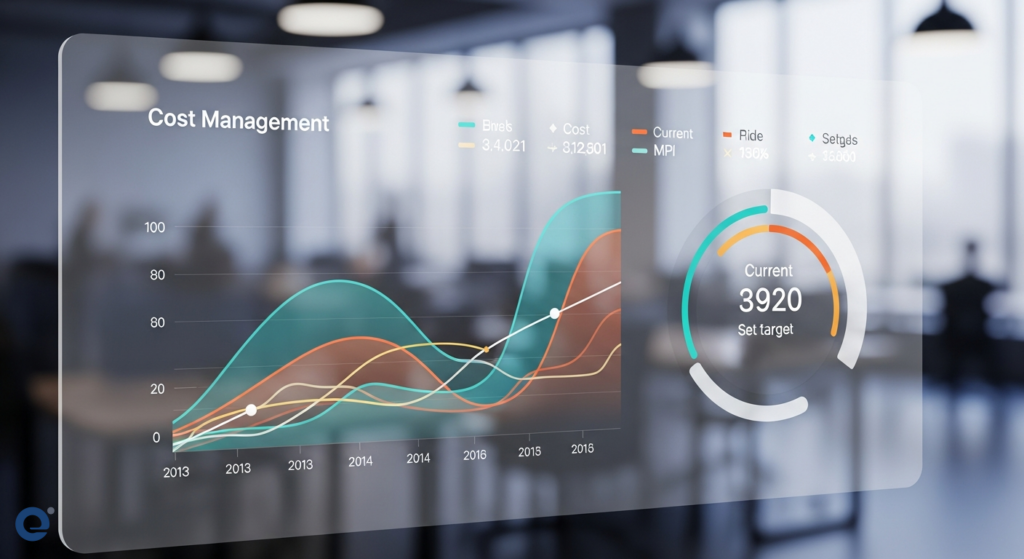
Establish a regular reporting schedule. This could be weekly, monthly, or quarterly, depending on the KPI. Dashboards are excellent tools for visualizing KPI performance. They provide a quick overview of progress and highlight areas needing attention. Consider how these reports will be shared with relevant stakeholders.
Step 4: Analyze and Act on Performance Data
Collecting data is only half the battle. The real value comes from analyzing the results and taking action. Regularly review your KPI dashboards and reports. Look for trends, deviations, and anomalies.
If a KPI is not meeting its target, investigate the root cause. Is it a process issue? A resource constraint? A change in market conditions? Once the cause is identified, develop and implement corrective actions. This might involve process improvements, training, or renegotiating contracts.
For instance, if ‘Contract Negotiation Cycle Time’ is increasing, analyze the negotiation process. Perhaps there are too many approval steps. Streamlining these could reduce costs and improve efficiency. You might also explore advanced negotiation tactics to secure better terms.
Step 5: Review and Refine KPIs Regularly
The business environment is dynamic. Therefore, your KPIs should not be static. Periodically review your KPI framework. Are the current KPIs still relevant? Do they accurately reflect your strategic priorities? Are they driving the desired behaviors?
As your department evolves, you may need to adjust existing KPIs or introduce new ones. This continuous refinement ensures your KPI system remains a powerful tool for cost control and strategic alignment.
Common Challenges and Best Practices
Implementing KPI-based cost control is not without its hurdles. However, understanding these challenges and applying best practices can lead to greater success.
Common Challenges
- Selecting the Wrong KPIs: Choosing metrics that don’t align with strategic goals or are too complex to measure.
- Data Inaccuracy or Unavailability: Lack of reliable data sources or inconsistent data collection methods.
- Lack of Ownership: No clear accountability for tracking and acting on KPIs.
- Resistance to Change: Employees may be hesitant to adopt new monitoring systems or feel scrutinized.
- Analysis Paralysis: Collecting data but failing to take meaningful action.
- Over-Complication: Trying to track too many metrics, leading to confusion and reduced focus.
Best Practices for Success
- Start Simple: Begin with a few critical KPIs and gradually expand as you gain experience.
- Ensure Alignment: All KPIs must clearly link to departmental and organizational objectives.
- Foster a Data-Driven Culture: Encourage the use of data for decision-making at all levels.
- Communicate Clearly: Explain the purpose and importance of KPIs to your team.
- Celebrate Success: Acknowledge and reward teams or individuals who achieve KPI targets.
- Regularly Review and Adapt: Keep your KPI framework relevant by reviewing and updating it as needed.
- Utilize Technology: Leverage performance management software or dashboards to streamline data collection and reporting.
For instance, to combat resistance to change, focus on how KPIs empower employees by providing clear goals and feedback. Transparency about how data is used is also key. For departments struggling with complex data, consider exploring cost control tools that can simplify data aggregation and analysis.
Conclusion: Driving Efficiency Through KPI-Led Cost Control
Implementing KPI-based monitoring for departmental cost control is a strategic imperative. It transforms cost management from a reactive process into a proactive, data-driven discipline. By carefully selecting, defining, and monitoring the right KPIs, department heads and controllers can gain unprecedented insight into their spending patterns.
This allows for targeted interventions, improved operational efficiency, and ultimately, significant cost savings. Furthermore, it fosters a culture of accountability and continuous improvement. As Source 1 notes, performance evaluation in complex sectors requires a comprehensive and thoughtful approach. KPIs provide that essential framework.
In conclusion, embrace KPIs not as a bureaucratic burden, but as a powerful tool. Use them to steer your department towards greater financial health and operational excellence. This disciplined approach will undoubtedly lead to more sustainable cost control and enhanced overall organizational performance.
Frequently Asked Questions (FAQ)
What is the primary benefit of using KPIs for cost control?
The primary benefit is gaining clear, quantifiable insights into spending and performance. This allows for data-driven decisions, proactive problem-solving, and improved efficiency, leading to significant cost savings.
How many KPIs should a department track?
Generally, it’s recommended to track between 5 and 7 key KPIs. This number is manageable and allows for focused attention on the most critical metrics without becoming overwhelming.
Can KPIs help identify cost-saving opportunities?
Absolutely. By tracking specific metrics like cost per unit, budget adherence, or vendor performance, you can pinpoint areas of inefficiency or overspending, thereby uncovering opportunities for cost reduction.
What is the difference between an indicator and a KPI?
An indicator is any metric that shows performance. A KPI, however, is a specific, critical indicator that directly measures progress towards a key strategic objective, such as controlling departmental costs.
How do I ensure my team is on board with KPI implementation?
Effective communication is key. Explain the ‘why’ behind KPIs, involve the team in defining them, and show how they benefit everyone by improving efficiency and achieving departmental goals. Transparency and celebrating successes also help.
