
Operations Excellence Managers constantly seek ways to improve efficiency. Lean management principles offer a powerful framework. They focus on eliminating waste and maximizing value. This approach can transform complex workflows. It leads to better outcomes and happier teams.
What is Lean Management?
Lean management originated from the Toyota Production System (TPS). It’s a philosophy. It aims to deliver maximum value to the customer. Simultaneously, it strives to minimize waste. This means cutting out unnecessary activities. It’s about doing more with less.
Lean is not just for manufacturing. It applies to many industries. This includes healthcare and software development. The core idea remains the same: improve processes continuously. By doing so, organizations can achieve better results. They can also use fewer resources.
The 5 Core Principles of Lean
Lean management is built on five fundamental principles. These guide teams toward greater efficiency. They help identify and eliminate waste. They also focus efforts on what truly matters.
1. Identify Value
Firstly, understand what your customer truly needs. Value is what the customer is willing to pay for. For internal processes, value is what the next step in the process needs. Activities that don’t contribute to this are often waste.
Lean distinguishes between value-adding and non-value-adding activities. Some non-value-adding activities are necessary. For example, testing a product is necessary but doesn’t directly add value for the customer. However, pure waste is non-essential. It should be removed entirely.
2. Map the Value Stream
Next, visualize your entire process. This is called mapping the value stream. It shows how work flows from start to finish. It highlights where waste occurs. Tools like Kanban boards are very useful here.
A basic Kanban board has columns like “Requested,” “In Progress,” and “Done.” You can add more stages. This visibility helps identify and remove steps that don’t add value. It makes the entire process clearer.
3. Create Flow
After mapping, focus on creating a smooth flow. Flow means work moves through the process without interruptions. Delays, bottlenecks, and waiting times disrupt flow.
To improve flow, remove bottlenecks. Limit the amount of work in progress (WIP). This prevents multitasking. It also reduces delays. Encourage team discussions to set clear WIP limits. Reducing context switching also helps.
4. Establish a Pull System
A pull system means work is only done when there is demand. It contrasts with a push system. In a push system, work is assigned regardless of current capacity. A pull system ensures you produce only what is needed, when it is needed.
This prevents overproduction. Overproduction is a major form of waste. It ties up capital and storage space. It also creates excess inventory. Just-in-Time (JIT) inventory is a key concept related to pull systems.
5. Seek Continuous Improvement
Finally, Lean is about ongoing improvement. This is also known as Kaizen. It means constantly looking for ways to refine processes. The goal is to enhance efficiency and quality over time.
This involves empowering employees. They are often the ones who understand the processes best. Their ideas are crucial. Leadership support is also essential for creating a culture of continuous improvement.
Identifying and Eliminating Waste
A key aspect of Lean is waste reduction. The TIMWOODS acronym helps identify common types of waste.
- Transportation: Unnecessary movement of materials or information.
- Inventory: Excess stock that ties up capital.
- Motion: Unnecessary physical movement by employees.
- Waiting: Delays due to idle time or bottlenecks.
- Overproduction: Producing more than is needed.
- Over-processing: Performing redundant or unnecessary tasks.
- Defects: Errors requiring rework or correction.
- Skill (Unused Talent): Underutilizing employee skills.
For instance, excessive movement of documents between departments is transportation waste. Stockpiling supplies beyond immediate needs is inventory waste. Waiting for approvals causes waiting time. Errors in data entry lead to defects.
Identifying and eliminating these wastes is crucial for efficiency. It uncovers opportunities for optimization. By addressing waste, workflows become streamlined. Overall productivity increases.
Lean Tools and Techniques in Action
Several tools and techniques support Lean implementation. They help visualize, organize, and improve processes.
5S Methodology: Workplace Organization
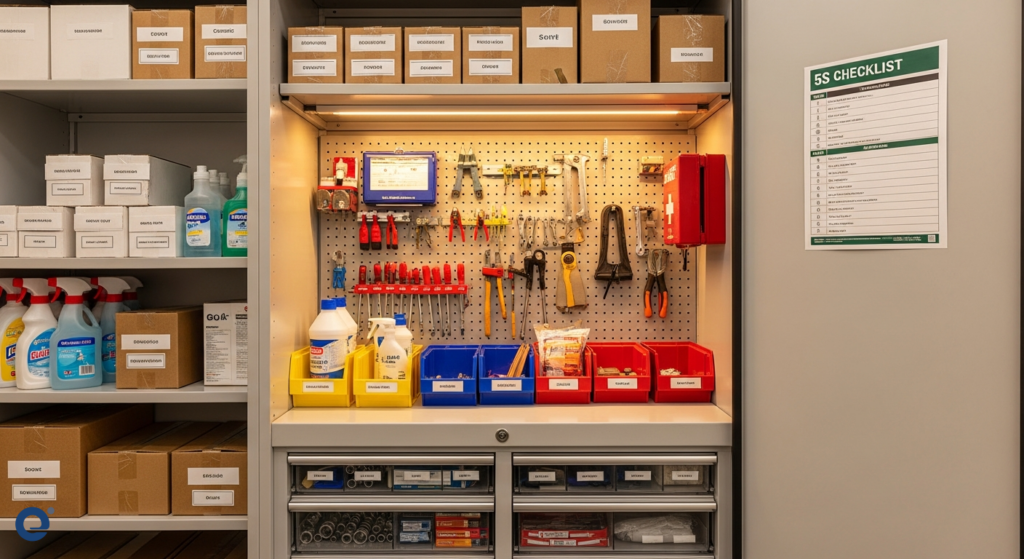
The 5S methodology is a systematic approach to workplace organization. It aims to improve efficiency and reduce waste. The steps are:
- Sort: Remove unnecessary items.
- Set in Order: Arrange remaining items logically.
- Shine: Clean and maintain the workspace.
- Standardize: Create standard procedures.
- Sustain: Continuously monitor and improve the system.
In a busy pre- and postprocedure care area, optimizing supply cabinets is a practical application of 5S. This ensures staff can find what they need quickly. It reduces wasted time searching for supplies.
Value Stream Mapping (VSM)
VSM is a visual tool. It analyzes how materials and information flow through a process. It helps identify bottlenecks and non-value-added activities. VSM fosters collaboration. It promotes a shared understanding of the process.
Kaizen Events (Rapid Improvement Events)
Kaizen events, or RIEs, are focused workshops. They aim for significant process improvements in a short time. A cross-functional team works together. They identify and implement solutions to specific problems. These events promote employee engagement and teamwork.
For example, a hospital used a Rapid Improvement Event (RIE) to improve pre- and postprocedure care workflows. They formed a cross-functional team. This team targeted workflow gaps. They implemented changes over four months. At baseline, only 45% of patients were prepared within 60 minutes. After the RIE, 80% were prepared within that timeframe. This shows the power of focused Lean initiatives.
Implementing lean management strategies like daily management systems and huddles helps eliminate waste. Establishing standard work confirmation is key. It creates systems that sustain improvements.
Standard Work and Daily Management
Standard work defines the best way to perform a task. It ensures consistency. Daily management systems, including huddles, reinforce standard work. They allow teams to discuss issues quickly. They help maintain focus on improvement goals.
Standardizing nursing preprocedure documentation is one example. This ensures all necessary information is gathered consistently. It reduces errors and delays. Confirming standard work in daily management huddles helps maintain these improvements. This ensures everyone is aligned.
Benefits of Lean Workflow Optimization
Implementing Lean principles yields significant benefits. These extend across various operational areas.
- Reduced Waste: Directly addresses and minimizes the seven types of waste.
- Improved Efficiency: Streamlined processes lead to faster task completion.
- Enhanced Quality: Standardized processes and defect reduction improve output quality.
- Cost Reduction: Less waste and more efficiency naturally lower operational costs. For example, optimizing internal communications spend can be achieved through Lean principles. This can be seen in optimizing internal comms spend.
- Increased Customer Satisfaction: Faster, higher-quality delivery meets customer needs better.
- Higher Employee Morale: Empowered teams and reduced frustrations lead to better job satisfaction.
- Shorter Lead Times: Processes move more quickly from start to finish.
In a clinical laboratory setting, optimizing the pre-analytical phase using Lean can improve test result delivery times. This enhances user satisfaction. It ensures efficient delivery of analytical results.
Lean management principles in the pre-analytical phase can significantly impact lab operations.
Implementing Lean: A Practical Approach
Implementing Lean requires a structured approach. It’s a journey, not a destination.
Start with a Pilot Project
Begin with a small, manageable pilot project. This allows the team to learn and adapt. It builds confidence for larger initiatives. Choose a process with clear pain points.
Form a Cross-Functional Team
Involve people from different departments. This brings diverse perspectives. It ensures buy-in from all stakeholders. A cross-functional team was essential in the hospital example.
Engage Employees
Employees are your greatest asset. They understand the day-to-day realities of the workflow. Involve them in identifying problems and solutions. Encourage their suggestions. Respect for people is a core Lean tenet.
Empowering employees leads to more creative solutions. It fosters a sense of ownership. This is vital for sustaining improvements. Organizations should provide training and resources. This empowers them to participate. The BA often takes responsibility to lead these activities.
Measure and Monitor
Establish key performance indicators (KPIs). Track progress regularly. Measure before and after changes. This demonstrates the impact of Lean. It also identifies areas needing further attention.
Foster a Culture of Continuous Improvement
Lean is a mindset. It requires ongoing commitment. Leadership support is crucial. Celebrate successes. Learn from failures. Make continuous improvement a part of the daily routine.
The goal is to embed Lean thinking into the organizational culture. This ensures long-term success. It drives ongoing efficiency gains.
Common Challenges in Lean Implementation
While beneficial, Lean implementation isn’t always easy. Managers may face several hurdles.
- Resistance to Change: Employees may be accustomed to old ways of working.
- Lack of Leadership Commitment: Without strong leadership, initiatives can falter.
- Insufficient Training: Teams may not understand Lean principles or tools.
- Focusing on Tools, Not Principles: Implementing tools without understanding the underlying philosophy is ineffective.
- Ignoring Employee Input: Failing to involve frontline staff can lead to poor solutions.
- Unrealistic Expectations: Expecting overnight results can lead to disappointment.
Overcoming these challenges requires clear communication. It also needs persistent effort and adaptability. Understanding the opportunity cost of maintaining outdated business processes can motivate change.
Frequently Asked Questions (FAQ)
What is the main goal of Lean management?
The main goal of Lean management is to maximize customer value while minimizing waste.
Can Lean principles be applied outside of manufacturing?
Yes, Lean principles are highly adaptable and can be applied to various industries, including healthcare, software development, and administrative services.
What are the 7 types of waste in Lean?
The 7 types of waste are Transportation, Inventory, Motion, Waiting, Overproduction, Over-processing, and Defects. Some also include Unused Talent.
How does 5S contribute to workflow optimization?
5S organizes the workspace, making it more efficient and reducing time wasted searching for items or dealing with clutter.
What is the role of leadership in Lean implementation?
Leadership plays a critical role in championing Lean initiatives, providing resources, and fostering a culture of continuous improvement.
How quickly can I expect to see results from Lean implementation?
While some quick wins are possible, significant and sustainable results often take time. Lean is a journey of continuous improvement.
Conclusion
Utilizing Lean management principles is a strategic imperative for Operations Excellence Managers. By focusing on identifying value, mapping the value stream, creating flow, establishing pull systems, and pursuing continuous improvement, organizations can dramatically optimize their workflows.
Eliminating waste and empowering teams leads to tangible benefits. These include reduced costs, improved quality, and increased efficiency. While challenges exist, a structured approach and a commitment to Lean principles pave the way for sustained success. Embracing Lean thinking is key to building resilient and high-performing operations.
