
Rapid Growth vs. Gradual Expansion: A Cost Analysis
Published on Tháng 12 23, 2025 by Admin
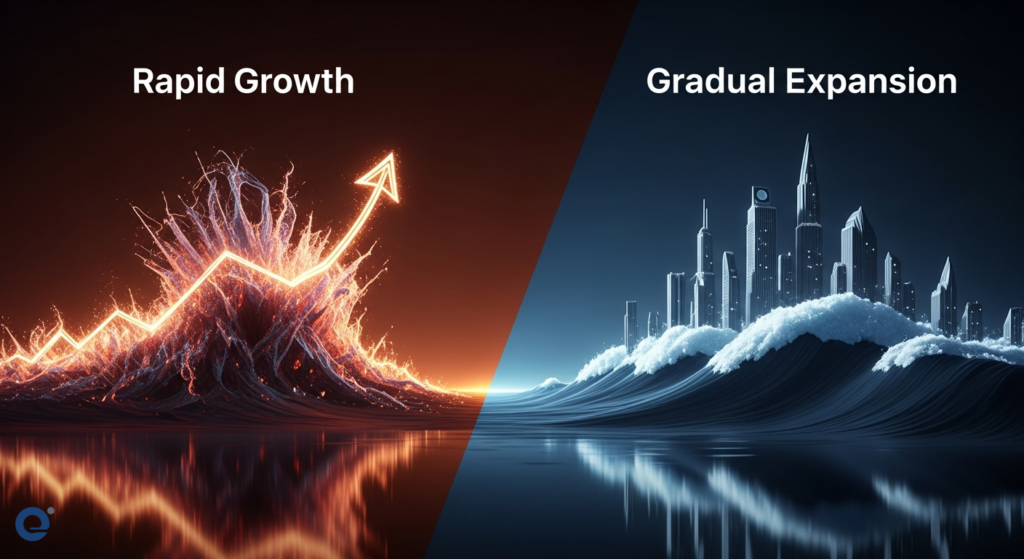
Expanding a business is a critical step. It requires careful consideration of costs. Two main strategies emerge: rapid growth and gradual market penetration. Each path has unique financial implications. Understanding these differences is key for strategy leads and expansion managers. This article explores the cost analysis of these two approaches.

The Core Strategies: Organic vs. Inorganic Growth
Business growth can be broadly divided into two categories. These are organic and inorganic growth. Organic growth comes from within. It involves increasing sales and developing new products. Inorganic growth, on the other hand, comes from external sources. This includes mergers and acquisitions. Understanding this fundamental difference helps frame the cost analysis.
Organic Growth: The Sustainable Path
Organic growth is a gradual expansion. It relies on internal resources and innovations. Companies increase sales through market penetration. They also develop new products or services. This is often seen as a more sustainable and controlled form of expansion. It evolves from the company’s existing framework.
Management typically knows the company intimately. This allows for quicker adaptation to market changes. There are usually fewer integration challenges and less restructuring. This can feel more natural for the internal culture. Entrepreneurs also maintain more control over the business direction.
Pros of Organic Growth
- Deep Company Knowledge: Management understands strategies and operations well. This leads to better adaptability.
- Smoother Integration: Changes are gradual, minimizing disruption to company culture.
- Strategic Control: Entrepreneurs retain full control over the business’s vision.
- Sustainability: It builds a foundation for long-term success.
Cons of Organic Growth
- Slower Pace: Growth can be significantly slower. It depends on available personnel and resources.
- Competitive Disadvantage: Growing too slowly can mean being overtaken by faster competitors.
- Resource Limitations: Companies may lack the resources for rapid scaling.
This slower pace means that companies must be patient. However, it builds a strong, internal foundation. For instance, building brand awareness organically takes time. Yet, the resulting loyalty can be very strong.
Inorganic Growth: The Accelerated Approach
Inorganic growth involves external factors. Mergers, acquisitions, and strategic alliances are common. This strategy allows for substantial growth in a shorter timeframe. It leverages the strengths and resources of other entities. It is characterized by the infusion of external capital, talent, or market presence.
While it offers quick market entry, it comes with challenges. Integration issues and cultural differences are significant concerns. Effective strategic alignment is crucial for long-term success. This type of growth often requires substantial upfront investment.
Pros of Inorganic Growth
- Rapid Market Entry: Achieve substantial growth quickly.
- Acquire New Markets/Technologies: Gain immediate access to new customer bases or innovative technologies.
- Increased Scale: Quickly expand operational capacity and market reach.
- Synergies: Potential for cost savings and revenue enhancements through combined operations.
Cons of Inorganic Growth
- High Upfront Costs: Acquisitions and mergers are expensive.
- Integration Challenges: Merging systems, cultures, and teams can be complex and costly.
- Risk of Overpayment: Companies may pay a premium for acquisitions.
- Loss of Control: Less direct control compared to organic growth.
The costs associated with inorganic growth can be significant. They include the purchase price, legal fees, and integration expenses. However, the potential rewards are also substantial.
Cost Analysis: Rapid Growth vs. Gradual Penetration
When analyzing costs, rapid growth and gradual penetration present distinct profiles. Rapid growth often implies inorganic strategies. Gradual penetration typically aligns with organic growth. Let’s break down the cost factors for each.
Rapid Growth: The High-Investment, High-Reward Path
Rapid growth strategies often involve significant upfront investment. This can include the acquisition of competitors or entire companies. For example, acquiring another business means paying a purchase price. There are also substantial legal and due diligence costs involved. Furthermore, integrating the acquired entity requires investment in systems, personnel, and rebranding.
Marketing costs can also be higher. To quickly capture market share, aggressive marketing campaigns are often necessary. This might involve large-scale advertising and promotional offers. Consider the cost of a major product launch designed to disrupt the market. This often requires a substantial marketing budget.
Penetration pricing is a key tactic here. This strategy involves setting a low initial price. The goal is to rapidly gain a significant market share. This attracts a large number of customers quickly. For instance, a new smartphone entering a competitive market might be priced below rivals. This encourages early adoption by price-sensitive consumers.
However, this low pricing strategy impacts short-term profitability. The company accepts lower margins initially. The expectation is to recoup these costs later. This requires careful planning for price increases or introducing complementary services. Penetration pricing aims to build a wider customer base that may have been difficult to reach previously.
The costs of rapid expansion can be summarized as:
- Acquisition costs (purchase price, legal fees).
- Integration costs (systems, personnel, rebranding).
- Aggressive marketing and advertising expenses.
- Initial low-profit margins due to penetration pricing.
- Potential for overpaying for assets or market share.
On the other hand, rapid growth can lead to quick economies of scale. Increased sales volumes can reduce per-unit production costs. This strategy is particularly beneficial in markets where consumer price elasticity is high.
Gradual Penetration: The Measured, Cost-Conscious Approach
Gradual market penetration focuses on organic growth. The costs here are typically more distributed over time. Instead of large acquisition outlays, investment is in internal development.
This includes research and development for new products. It also involves building sales teams and expanding distribution channels organically. Marketing efforts are often more targeted and sustained. The focus is on building brand loyalty and customer relationships over time.
Costs might include:
- Investment in R&D for product innovation.
- Hiring and training new staff for expansion.
- Developing and optimizing sales and distribution networks.
- Targeted marketing campaigns focused on customer acquisition and retention.
- Building infrastructure to support gradual scaling.
While the pace is slower, the financial risk is often lower per period. Companies can reinvest profits back into the business. This allows for a more controlled expansion. It also minimizes the risk of significant financial strain if market conditions change unexpectedly.
A key aspect of gradual penetration is often optimizing existing processes. For instance, improving operational efficiencies can reduce costs without requiring major external investment. This can be seen in efforts to minimize product defects and repair costs, which directly impacts profitability.
Furthermore, gradual expansion allows for better management of cash flow. Companies are less likely to incur massive debt for rapid expansion. This approach is often favored by investors who prioritize sustainable growth over quick wins.
Key Cost Considerations and Trade-offs
Choosing between rapid growth and gradual penetration involves significant trade-offs. Each strategy has a different cost structure and risk profile.
Market Share vs. Profitability
Rapid growth often prioritizes market share. Penetration pricing is a common tool for this. However, this can severely impact short-term profitability. Companies might operate at a loss for an extended period. The long-term goal is to leverage market dominance for future profits.
Gradual penetration balances market share growth with profitability. While market share may increase more slowly, profit margins are often healthier from the outset. This ensures the business remains financially stable throughout the expansion process.
Risk Tolerance and Investment Horizon
Rapid growth typically suits companies with a higher risk tolerance and a shorter investment horizon. They are willing to invest heavily upfront for potentially faster returns. This might involve external funding like venture capital.
Gradual penetration is ideal for businesses with a lower risk tolerance or a longer-term strategic outlook. They prefer to grow steadily, reinvesting profits and minimizing external debt. This approach is often more aligned with building long-term, sustainable value.
Integration and Operational Complexity
Inorganic growth, driving rapid expansion, often brings significant integration challenges. Merging different company cultures, IT systems, and operational processes can be complex and costly. Failure to integrate effectively can negate the benefits of the acquisition.
Organic growth, leading to gradual penetration, generally involves less operational complexity. The company expands its existing structures. This allows for smoother scaling and adaptation. It’s easier to manage the costs associated with internal growth.
Brand Building and Customer Loyalty
Rapid market entry through acquisition might bring an established customer base. However, building genuine brand loyalty can be harder. Customers might be acquired, not converted.
Gradual penetration allows for organic brand building. It fosters deeper customer relationships. This can lead to stronger, more sustainable customer loyalty over time. This loyalty is invaluable as the company grows.
Choosing the Right Strategy for Your Business
The decision between rapid growth and gradual penetration is not one-size-fits-all. It depends on several factors:
- Industry Dynamics: Is the market highly competitive with rapid M&A activity? Or is it more stable?
- Financial Resources: Does the company have the capital for significant upfront investment?
- Risk Appetite: How much risk is the company willing to take?
- Strategic Goals: Is the primary objective quick market dominance or long-term sustainable growth?
- Competitive Landscape: What are competitors doing? Is there a need to keep pace?
For example, a tech startup might need rapid growth to gain market share before a disruptive technology becomes obsolete. Conversely, a mature manufacturing company might opt for gradual penetration to optimize its existing operations and expand into adjacent markets slowly.
Many businesses adopt a hybrid approach. They might pursue strategic acquisitions for quick wins in certain areas while simultaneously investing in organic product development. This balances the need for speed with the desire for sustainable, controlled growth.
FAQ: Cost Analysis for Market Expansion
What is the main cost difference between rapid growth and gradual market penetration?
Rapid growth typically involves high upfront costs from acquisitions, integration, and aggressive marketing. Gradual penetration spreads costs over time, focusing on internal development and organic marketing efforts.
When is penetration pricing most effective?
Penetration pricing is most effective when entering a new, competitive market or launching a new product. It’s designed to rapidly gain market share by attracting price-sensitive customers.
What are the risks associated with rapid growth strategies?
Risks include high upfront investment, integration challenges, potential overpayment for acquisitions, and lower initial profitability due to aggressive pricing.
How does gradual penetration impact long-term profitability?
Gradual penetration often leads to healthier profit margins from the start. It allows for reinvestment of profits and sustainable growth, which can build long-term profitability and stability.
Can a company use both rapid and gradual expansion strategies?
Yes, many companies adopt a hybrid approach. They might use acquisitions for quick expansion in some areas while pursuing organic growth for core business development. This offers a balance between speed and sustainability.
Conclusion
The cost analysis for market expansion reveals a clear dichotomy between rapid growth and gradual penetration. Rapid growth, often fueled by inorganic strategies, demands significant upfront investment but offers the potential for swift market dominance. Conversely, gradual penetration, typically organic, involves a more distributed cost structure, prioritizing sustainability and controlled scaling. Understanding your company’s risk tolerance, financial resources, and strategic objectives is paramount. By carefully weighing these factors, expansion managers and strategy leads can choose the most cost-effective and successful path forward. Ultimately, the right strategy is the one that aligns with the business’s long-term vision and market realities.
