
Slash Factory Waste: A Guide for Vietnam Plant Managers
Published on Tháng 1 31, 2026 by Admin
Vietnam’s manufacturing sector is growing at an incredible pace. This rapid expansion, however, brings significant challenges. One of the biggest hidden costs is material waste. It silently eats away at your profits and dulls your competitive edge. For production managers, tackling this issue is no longer optional; it is essential for survival and growth.
Fortunately, reducing waste is an achievable goal. It involves a combination of smart strategies, proven methods, and a strong team culture. This guide offers practical, actionable steps you can take to cut material waste in your plant. As a result, you can boost efficiency, lower costs, and build a more sustainable operation.
Why Material Waste is a Critical Issue in Vietnam
Material waste is much more than just discarded scraps. In fact, it represents a direct financial loss. Every piece of raw material that doesn’t become part of a finished product is money thrown away. This includes off-cuts, defects, spoiled inventory, and overproduction.
Moreover, waste is a clear sign of inefficiency. It points to problems in your processes, equipment, or employee training. High waste levels can mean your machines are poorly calibrated, your workers are making frequent errors, or your inventory management is flawed. Addressing waste, therefore, helps you fix the root causes of these deeper operational problems.
Think of it this way: every dollar saved from waste reduction goes directly to your bottom line. It’s often easier to save money by improving efficiency than by increasing sales.
In addition, customers and partners around the world are increasingly demanding sustainable manufacturing. By reducing your factory’s environmental footprint, you become a more attractive partner for global brands. This can open up new business opportunities and enhance your company’s reputation.
Adopting Lean Principles to Combat Waste
Lean manufacturing is a philosophy focused on maximizing value by eliminating waste. It provides a powerful framework for any production manager. Instead of a complex overhaul, you can start with a few fundamental principles.
The 5S Method: Your Foundation for a Clean Factory
The 5S method is a perfect starting point. It organizes your workspace for maximum efficiency and safety. A disorganized plant floor directly leads to mistakes and waste. Therefore, implementing 5S is a foundational step.
- Sort (Seiri): First, remove all unnecessary items from the work area. This clears clutter and makes it easier to find what you actually need.
- Set in Order (Seiton): Next, organize the remaining items. Create a logical, designated place for every tool and material.
- Shine (Seiso): Then, clean the workspace thoroughly. A clean environment makes it easier to spot leaks, spills, or other potential problems.
- Standardize (Seiketsu): After that, create clear, simple standards for the first three steps. This ensures consistency across all shifts and teams.
- Sustain (Shitsuke): Finally, make 5S a long-term habit. This requires regular audits and continuous reinforcement from management.
Kaizen: Empowering Your Team for Continuous Improvement
Kaizen is the principle of continuous improvement. It is based on the belief that many small changes can lead to massive results over time. Crucially, Kaizen empowers the people who know the processes best: your workers on the factory floor.
You should encourage your team to identify small, everyday problems that create waste. For example, maybe a tool is stored too far away, causing delays. Or perhaps a specific machine setting consistently produces defects. By listening to your team and implementing their small suggestions, you build a culture of ownership and proactive problem-solving.
Leveraging Technology for Smarter Material Management
While Lean principles provide the philosophy, technology gives you the tools to execute it with precision. Modern software and hardware can help you track, measure, and control material usage in ways that were previously impossible.
Data is Your Best Friend: Tracking and Analysis
You cannot manage what you do not measure. Therefore, the first step is to collect accurate data. Enterprise Resource Planning (ERP) or Material Requirements Planning (MRP) systems are invaluable for this. They allow you to track every piece of material from the moment it enters your warehouse to the moment it leaves as a finished product.
With this data, you can perform a waste analysis. Identify which production lines, shifts, or processes generate the most scrap. This data-driven approach allows you to focus your improvement efforts where they will have the biggest impact.
Automating Processes to Reduce Human Error
Human error is a major source of material waste. Automation can significantly reduce this risk. For example, automated cutting machines can produce parts with far greater precision than manual methods, minimizing off-cuts.
Furthermore, Internet of Things (IoT) sensors can be installed on machinery to monitor performance in real-time. These sensors can predict when a machine needs maintenance before it starts producing defective parts. Consequently, you prevent waste before it even happens. This focus on efficiency also helps in reducing electricity bills in large Vietnamese factories, another key operational cost.
Building a Waste-Conscious Culture on the Factory Floor
Ultimately, your success depends on your people. You can have the best processes and the latest technology, but if your team isn’t engaged, your efforts will fall short. Building a culture where every employee cares about reducing waste is critical.
Training and Empowering Your Workforce
Effective training is the first step. Your team needs to understand not just *how* to do their jobs, but *why* doing them efficiently matters. Show them the real cost of waste. For instance, explain that one wasted part is equivalent to a certain amount of lost revenue.
In addition, empower your employees to take action. Give them the authority to stop the production line if they spot a quality issue that is creating waste. This sends a powerful message that you value quality and efficiency over pure output speed.
Incentivizing Waste Reduction Efforts
People respond to incentives. To accelerate your progress, create a system that rewards waste reduction. This could be a team-based bonus for meeting monthly scrap reduction targets.
You can also publicly recognize individuals or teams who come up with innovative waste-saving ideas. A simple “employee of the month” award for the best Kaizen suggestion can foster healthy competition and encourage more participation. As a result, your team becomes an active partner in your cost-saving mission.
Beyond the Factory Walls: Supply Chain and Disposal
Your influence on waste doesn’t end at your factory’s shipping dock. It extends both upstream to your suppliers and downstream to your disposal methods. A holistic approach is necessary for maximum impact.
Collaborating with Suppliers
Work closely with your raw material suppliers. Can they provide materials in sizes or shapes that better fit your production process, reducing initial off-cuts? Can they use returnable or recyclable packaging to eliminate container waste?
Open communication with your partners is key. A collaborative approach helps in streamlining supply chains for more profit and less waste for everyone involved. Sometimes, a small change from a supplier can lead to a big saving for you.
Smart Waste Segregation and Recycling
Not all waste is worthless. Many materials, like metal, plastic, and cardboard, can be recycled. However, this is only possible if the waste is properly segregated at the source.
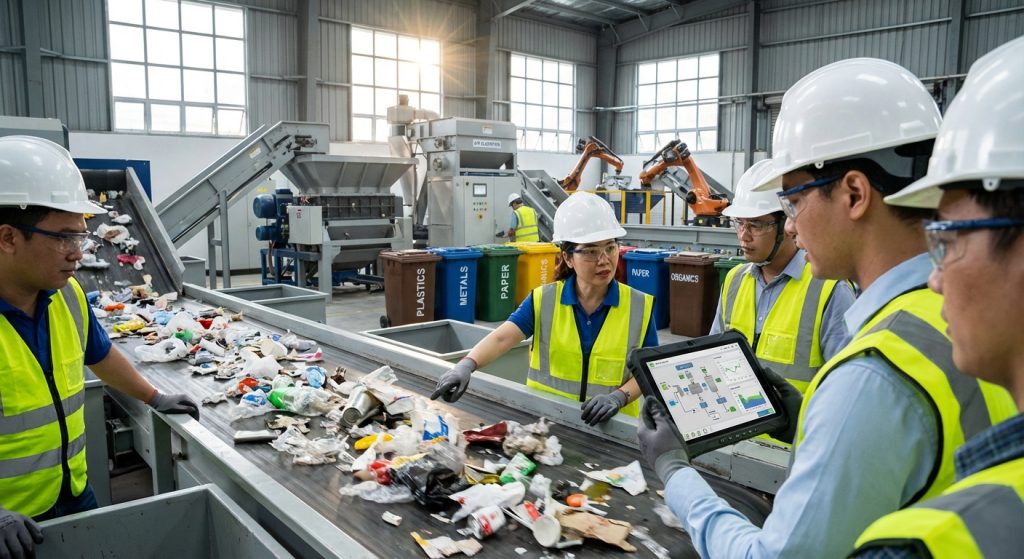
Implement a clear and simple sorting system on your factory floor. Use color-coded bins with clear labels in Vietnamese. Then, establish relationships with local recycling companies. In some cases, you may even be able to sell your scrap material, turning a cost center into a small revenue stream.
Frequently Asked Questions (FAQ)
What is the best first step to reducing material waste?
The best first step is to start small and focused. Don’t try to fix everything at once. Choose one production line or a specific area and conduct a simple waste audit. Simply observe and record the types and amounts of waste generated over a week. This data will give you a clear starting point. Applying the 5S method to that one area is also a fantastic, low-cost way to begin.
How can I get my employees to support these changes?
Getting employee buy-in is crucial. Firstly, communicate the “why” behind the changes. Explain how reducing waste improves company health, which leads to better job security. Secondly, involve them in finding solutions. Ask for their ideas and implement them. When people feel heard and valued, they are much more likely to support new initiatives.
Is implementing new technology to reduce waste always expensive?
Not necessarily. While some advanced automation can be a significant investment, many technological solutions are quite affordable. You can start with simple inventory tracking software or even well-designed spreadsheets. The key is to calculate the return on investment (ROI). Often, the money saved from reduced waste pays for the technology very quickly.
Your Path to a More Profitable Plant
Reducing material waste is a continuous journey, not a one-time project. It demands a strategic blend of proven methodologies like Lean, the smart application of technology, and most importantly, a dedicated and empowered team.
As a production manager in Vietnam, embracing this challenge will not only boost your factory’s profitability but also position it as a modern, sustainable, and competitive leader in the global market. Start today by taking one small step. Because in manufacturing, every gram of material saved is a victory won.
