
AI Frame Prediction: The Token Buffer Advantage for ADAS
Published on Tháng 1 25, 2026 by Admin
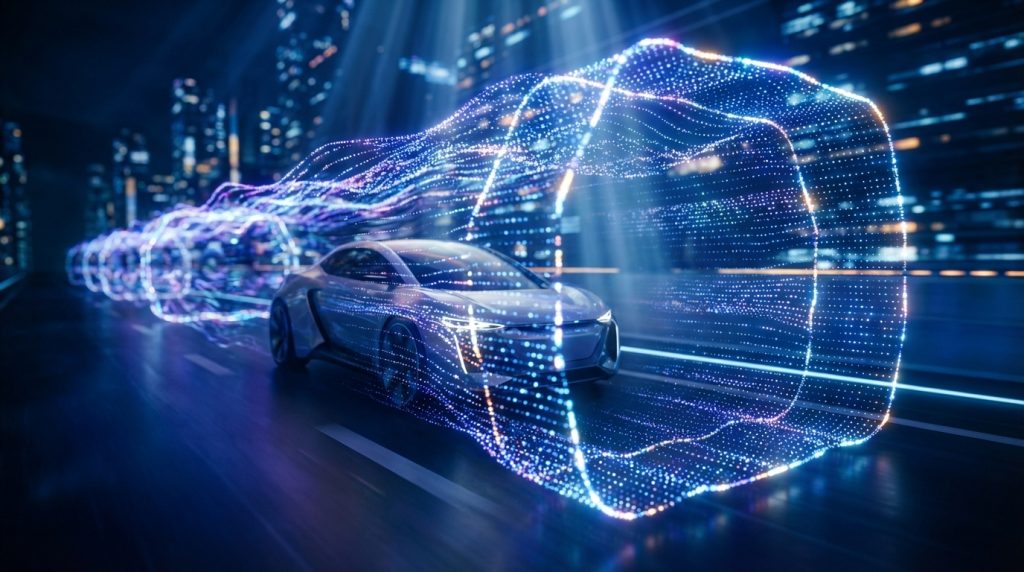
For auto industry engineers, the race to develop safer and more reliable autonomous systems is paramount. A key technology in this race is high-speed frame prediction. However, traditional methods are often too slow for real-world driving scenarios. This article explores a powerful solution: using token buffers to accelerate AI-driven frame prediction.
In short, this technique dramatically reduces computational load. As a result, it enables faster, more efficient decision-making for Advanced Driver-Assistance Systems (ADAS) and fully autonomous vehicles. We will cover the fundamentals of this approach and its direct benefits for automotive applications.
The Critical Need for Speed in Automotive AI
Modern vehicles are packed with sensors. Cameras, LiDAR, and RADAR all generate massive amounts of data every millisecond. For an ADAS to be effective, it must process this data and predict potential hazards in real time. For instance, predicting the trajectory of a pedestrian or another vehicle requires incredibly low latency.
Any delay can be the difference between a safe maneuver and a collision. Therefore, the computational efficiency of the underlying AI models is not just a performance metric; it is a critical safety requirement. The challenge is to make complex predictions without overwhelming the vehicle’s onboard computing resources.
What is High-Speed Frame Prediction?
High-speed frame prediction is the process of using an AI model to generate future video frames based on a sequence of past frames. Essentially, the model learns the dynamics of a scene. Then, it anticipates what will happen next. This capability is fundamental for proactive vehicle behavior.
For example, an autonomous vehicle can use frame prediction to anticipate a car merging into its lane before it even happens. This allows the system to plan a smoother, safer response, such as adjusting its speed preemptively. Traditional approaches, however, often struggle to do this quickly enough.
Introducing Tokens: The Building Blocks of AI Vision
To understand the token buffer solution, we must first understand tokens. Modern vision models, like Vision Transformers (ViTs), don’t see images as a giant grid of pixels. Instead, they break the image down into smaller, manageable patches. Each patch is then converted into a numerical representation called a token.
This process, known as tokenization, transforms a visual problem into a sequence problem, similar to how language models process words in a sentence. Consequently, the model can analyze the relationships between different parts of the scene more effectively.
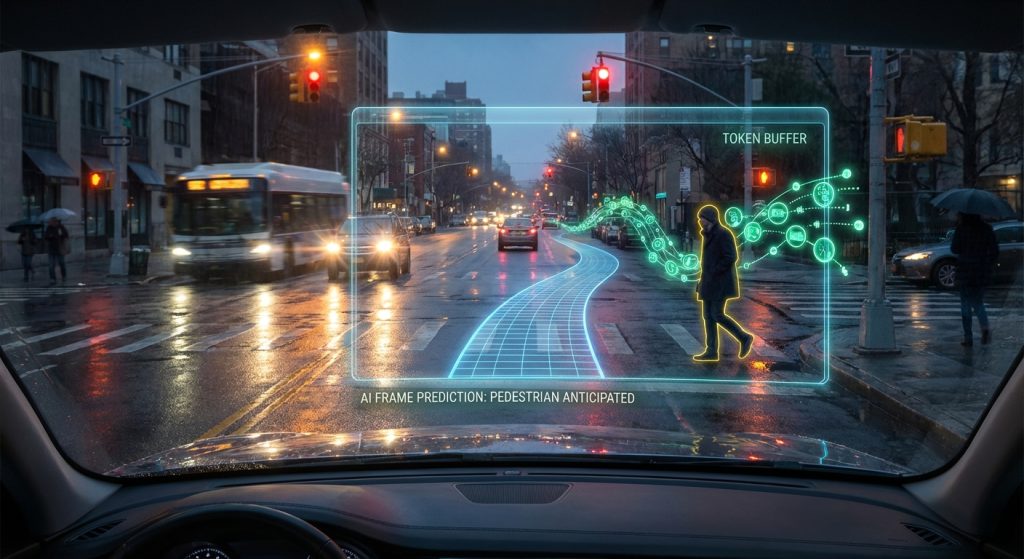
From Pixels to Patches: The Tokenization Process
The tokenization process is straightforward. First, a video frame is divided into a grid of non-overlapping patches. For example, a 224×224 pixel image might be split into 196 patches, each 16×16 pixels. Each patch is then flattened and passed through a linear projection to create a token.
This sequence of tokens becomes the input for the AI model. By focusing on patches instead of individual pixels, the model can capture spatial information more efficiently. However, processing a new set of tokens for every single frame remains computationally expensive.
Why Traditional Methods Fall Short
In a typical video stream from a car’s camera, much of the scene is static from one frame to the next. The sky, distant buildings, or the road surface often remain unchanged. Despite this, conventional frame prediction models re-process every single token for every new frame.
This redundant computation creates a significant bottleneck. It consumes valuable processing power and increases latency. As a result, the system’s reaction time suffers, which is unacceptable for safety-critical automotive applications.
The Token Buffer Solution: A Breakthrough in Efficiency
The token buffer is a clever and highly effective solution to this problem. Think of it as a smart cache that stores tokens from previous frames. Instead of re-calculating every token for a new frame, the model can reuse tokens from the buffer that correspond to static parts of the scene.
In other words, the system only spends its computational budget on the parts of the scene that are actually changing, like moving cars, cyclists, or pedestrians. This dynamic approach leads to massive efficiency gains.
How Token Buffers Reduce Computational Load
The core mechanism is an update strategy. Before processing a new frame, the system identifies which regions of the scene have changed significantly. It then generates new tokens only for these dynamic regions. The tokens for the static background are simply retrieved from the buffer.
This selective processing dramatically reduces the number of calculations required. The AI model can focus its attention on moving objects, which are the most important elements for making driving decisions. This concept is central to the idea of strategic token reuse in recurrent video models, where efficiency is gained by avoiding redundant work.
Benefits for Auto Industry Engineers
Implementing token buffers offers several tangible advantages for engineers working on ADAS and autonomous driving platforms. The benefits are clear and directly address major industry challenges.
- Lower Latency: By reducing computation, the model can predict future frames much faster, enabling quicker reactions to road events.
- Reduced Power Consumption: Fewer calculations mean less energy is used by the onboard processors. This is especially crucial for electric vehicles (EVs) where every watt counts.
- Improved Model Performance: The model can allocate more resources to analyzing complex, dynamic objects, potentially improving prediction accuracy.
- Enhanced Scalability: More complex and powerful prediction models can be deployed on existing hardware without requiring costly upgrades.
Implementing Token Buffers in Your Workflow
Adopting a token buffer approach requires changes to the model’s architecture. It involves adding a buffer management module that handles token storage, retrieval, and the update logic. Engineers must decide on the optimal buffer size and the threshold for detecting change between frames.
Furthermore, the strategy must be robust enough to handle sudden, large-scale scene changes, such as a rapid turn or entering a tunnel. Techniques for managing this, such as periodic full-frame updates, are essential for stability. This is closely related to methods for optimizing frame rates using temporal token slicing, which also aim to make video processing more efficient.
Future Outlook: The Road Ahead
The concept of token buffering is still evolving. Future research will likely focus on more sophisticated buffer management algorithms. For example, models might learn to predict which tokens are most likely to change, allowing for even more intelligent updates.
Additionally, we can expect to see this technique integrated with other sensor modalities. Tokenized data streams from LiDAR and RADAR could also be managed with buffers, creating a unified, highly efficient perception system. This will further enhance the safety and reliability of autonomous vehicles.
Frequently Asked Questions (FAQ)
How does a token buffer differ from a simple frame cache?
A simple frame cache stores entire past frames. In contrast, a token buffer operates at a much more granular level. It stores individual tokens (patches of a frame), which allows the system to update only the specific parts of the scene that have changed, rather than replacing the whole frame. This is far more efficient.
Is this technology only for autonomous vehicles?
No, not at all. While the automotive industry is a primary beneficiary, this technique is valuable for any application requiring real-time video analysis. This includes robotics, security and surveillance systems, augmented reality, and drone navigation. Any system that processes video streams can benefit from the computational savings.
What are the main challenges in implementing token buffers?
The primary challenges include designing an effective change detection mechanism to decide which tokens to update. Another challenge is managing the buffer’s memory and handling cache coherency. Finally, the system must be robust against abrupt, global scene changes to avoid prediction errors.
Can token buffers work with sensor data other than cameras?
Yes, absolutely. The underlying principle can be applied to any sequential data that can be tokenized. For example, a LiDAR point cloud can be converted into a set of tokens representing different spatial regions. A token buffer could then be used to efficiently process these streams, updating only the areas where movement is detected.
