
AI Animation Costs: A Studio’s Guide to Savings
Published on Tháng 1 24, 2026 by Admin
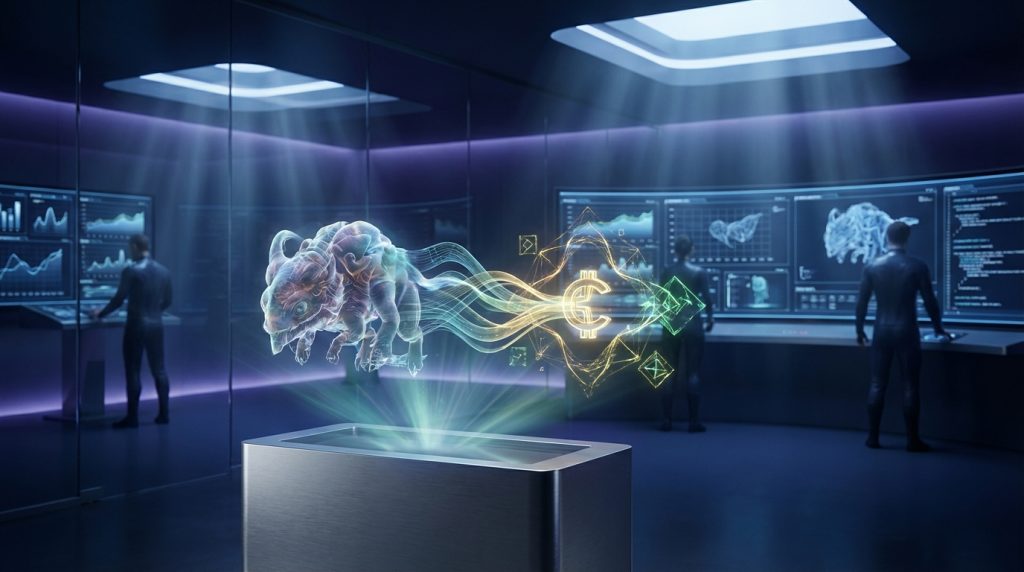
Generative AI is revolutionizing the animation industry. However, this incredible power comes with a significant cost. For animation studio owners, the expense of running AI models, known as inference costs, can quickly spiral out of control. These costs are a direct result of the intense computational power needed to generate each frame of animation.
Fortunately, you can take control of these expenses. By implementing a series of strategic optimizations, studios can dramatically lower their AI inference costs. This allows you to scale production without breaking the bank. Consequently, you can maintain creative momentum and a healthy bottom line.
This comprehensive guide will walk you through practical, actionable strategies. We will cover everything from choosing the right AI models to optimizing your technical infrastructure. As a result, you will be equipped to make informed decisions that save your studio money.
Understanding AI Inference Costs in Animation
Before we dive into solutions, it’s important to understand the problem. What exactly is “inference” and why is it so expensive for animation studios? In simple terms, inference is the process of using a trained AI model to generate new data. For your studio, this means creating images, video frames, or character movements.
Each time you ask an AI to generate a frame, it performs complex calculations. These calculations require powerful, and therefore expensive, hardware like GPUs (Graphics Processing Units). The more frames you generate, the more GPU time you use. As a result, your costs add up quickly, especially on large-scale animation projects.
The Main Cost Drivers
Several factors contribute to high inference costs. Firstly, model complexity plays a huge role. Larger, more powerful models produce stunning results but require more computational resources. Secondly, the resolution of your output matters. Generating a 4K frame is significantly more expensive than a 1080p one. Finally, the sheer volume of frames needed for animation makes this a constant operational expense.
Strategic Model Selection: Your First Line of Defense
Your journey to lower costs begins with the AI model itself. The model you choose has the single biggest impact on your overall spend. Therefore, making a smart choice here is absolutely critical for financial efficiency.
Open-Source vs. Proprietary Models
You generally have two paths: using open-source models or paying for proprietary APIs. Open-source models like Stable Diffusion offer incredible flexibility and control. You can host them yourself and fine-tune them for your specific style. However, this path requires technical expertise and managing your own hardware.
On the other hand, proprietary models from companies like OpenAI or Midjourney are easy to use. You simply pay per generation via an API. This eliminates the need for hardware management. The trade-off, however, is less control and potentially higher costs at scale. For many studios, a hybrid approach often works best.
The “Good Enough” Principle
It’s tempting to always use the largest, most advanced model available. However, this is often overkill and a major waste of money. Instead, adopt the “good enough” principle. Ask yourself if a smaller, faster model can accomplish a specific task effectively.
For example, you could use a highly complex model for main character close-ups but a much lighter model for generating background textures or simple props. This tiered approach ensures you only use expensive resources when absolutely necessary. Consequently, your overall costs will decrease significantly.
Technical Optimizations to Slash Compute Spend
Once you’ve selected your models, you can apply several technical optimizations. These techniques reduce the computational load of the model. As a result, each inference becomes faster and cheaper.
Model Quantization: Smaller Models, Faster Results
One of the most effective optimization techniques is called quantization. In essence, quantization reduces the precision of the numbers within the AI model. This process makes the model file size smaller and significantly speeds up calculations. Think of it like saving an image as a slightly lower-quality JPEG to reduce its file size.
While there can be a minor drop in output quality, it is often unnoticeable for many animation applications. The cost savings, however, are substantial. Implementing this can cut your inference time and costs by a large margin. In fact, many studios find the trade-off well worth it, and you can learn more about using quantized models for faster, cheaper generation in our detailed guide.
The Power of Batch Processing
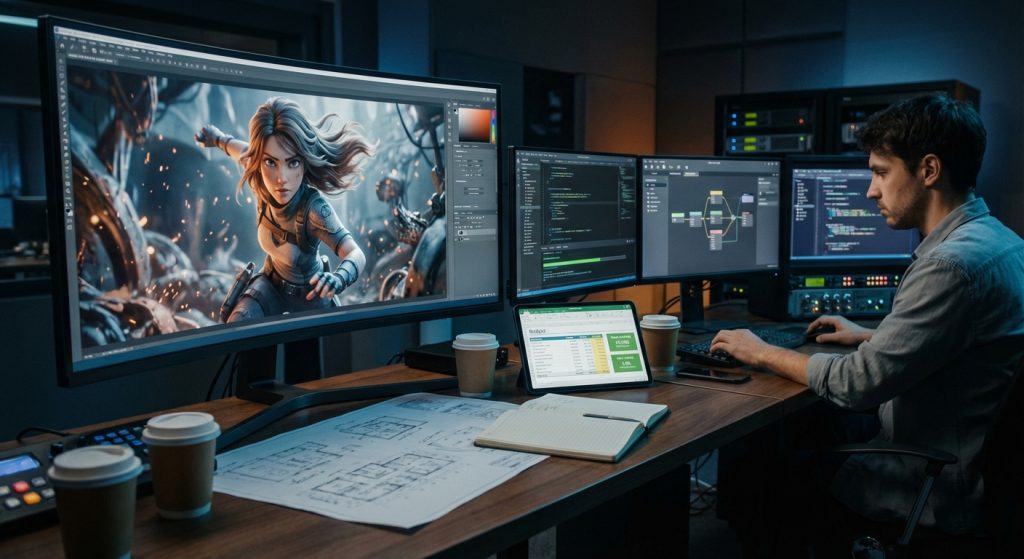
Another powerful strategy is batch processing. Instead of sending generation requests to the GPU one by one, you group them into a “batch.” The GPU can then process this entire batch of requests simultaneously. This method is far more efficient than handling individual requests.
Because the GPU is optimized for parallel tasks, batching maximizes its utilization. This reduces idle time and lowers the cost per generated frame. For animation pipelines that require thousands of frames, implementing batching is not just an option; it’s a necessity for cost control. This approach is crucial, and you can explore it further in our guide to batch AI image processing.
Pruning and Distillation
For studios with more technical resources, advanced techniques like pruning and distillation offer further savings. Pruning involves identifying and removing redundant parts of a neural network, making it smaller and faster without a major impact on quality.
Distillation, on the other hand, is the process of training a smaller, “student” model to mimic the behavior of a larger, “teacher” model. The student model learns to produce similar results but with a fraction of the computational cost. Both techniques require expertise but can lead to highly efficient, custom models for your studio.
Smart Hardware and Infrastructure Choices
Where you run your models is just as important as how you run them. Your hardware and cloud infrastructure decisions directly influence your monthly bill. Therefore, a strategic approach to infrastructure is key.
On-Demand GPUs vs. Reserved Instances
Cloud providers like AWS, Google Cloud, and Azure offer different pricing models for GPU access. On-demand instances provide flexibility, allowing you to pay by the hour. This is great for unpredictable workloads or experimentation.
However, if your studio has a consistent, round-the-clock animation pipeline, reserved instances are a much cheaper option. By committing to a one or three-year term, you can get significant discounts compared to on-demand pricing. Analyze your usage patterns to decide which model makes the most financial sense.
Exploring Serverless Inference
A newer option gaining popularity is serverless inference. With a serverless setup, you don’t manage any servers at all. You simply upload your model, and the cloud provider automatically handles scaling resources up and down as needed.
The biggest advantage is that you only pay for the exact compute time used during the inference, down to the millisecond. There are no costs for idle time. This makes serverless a fantastic, cost-effective option for projects with sporadic or unpredictable generation needs.
Workflow and Pipeline Optimization
Finally, look at your studio’s internal workflows. Simple changes in your production pipeline can prevent wasted computation and save a surprising amount of money. Efficiency is not just about technology; it’s also about process.
Caching Generated Assets
This might sound obvious, but it’s a common oversight. Never regenerate an asset that you have already created. Implement a robust asset management system with a caching layer. When a request for a specific asset comes in, the system should first check if it already exists in the cache.
If it does, the system serves the existing file instead of running a new inference. This simple step eliminates redundant computation. Consequently, it saves both time and money, especially in complex scenes with repeated elements.
Optimizing Prompt Engineering
The quality of your prompts directly affects your costs. A vague or poorly written prompt will require multiple attempts to get the desired result. Each of those attempts is another inference, another charge on your bill.
Invest time in training your artists on effective prompt engineering. Create a library of successful prompts for common assets and styles. Better prompts lead to better results on the first try. As a result, you reduce the number of costly iterations and streamline the creative process.
Frequently Asked Questions (FAQ)
What’s the easiest first step to lower AI costs?
The easiest and most impactful first step is to review your model choices. Ensure you are not using an overly powerful and expensive model for simple tasks. Start by identifying areas where a smaller, faster model would be “good enough.” This alone can yield immediate savings.
Is running my own open-source model cheaper than using an API?
It can be, but you must consider the Total Cost of Ownership (TCO). While you won’t pay per-image fees, you will have costs for hardware (renting or buying GPUs) and the salary for technical staff to manage the infrastructure. For high-volume studios, self-hosting is often cheaper in the long run. However, for smaller studios or short-term projects, using an API might be more economical.
Does quantization noticeably reduce animation quality?
It depends on the level of quantization and the specific model. In many cases, the reduction in quality is minimal and may not even be perceptible in the final animation. The best approach is to test it. Create a side-by-side comparison of a frame generated by the original model and the quantized model to see if the quality difference is acceptable for your project’s standards.
In conclusion, lowering AI inference costs is not about finding a single magic bullet. Instead, it requires a holistic approach that combines smart model selection, technical optimization, strategic hardware choices, and efficient workflows. By methodically addressing each of these areas, animation studio owners can unlock the full creative potential of AI without letting costs undermine their profitability. Start with small changes, measure their impact, and continuously refine your process for a more sustainable and cost-effective future.
