
Open Source vs Managed AI: A CTO’s Cost Breakdown
Published on Tháng 1 20, 2026 by Admin

The Allure of Open Source AI: More Than “Free”
Open source models, like Stable Diffusion or Llama, are incredibly appealing. Their main advantage is the lack of a licensing fee. This “free” entry point, however, can be deceptive. Consequently, you must look at the complete financial picture. The real investment comes from building and maintaining the entire ecosystem around the model.
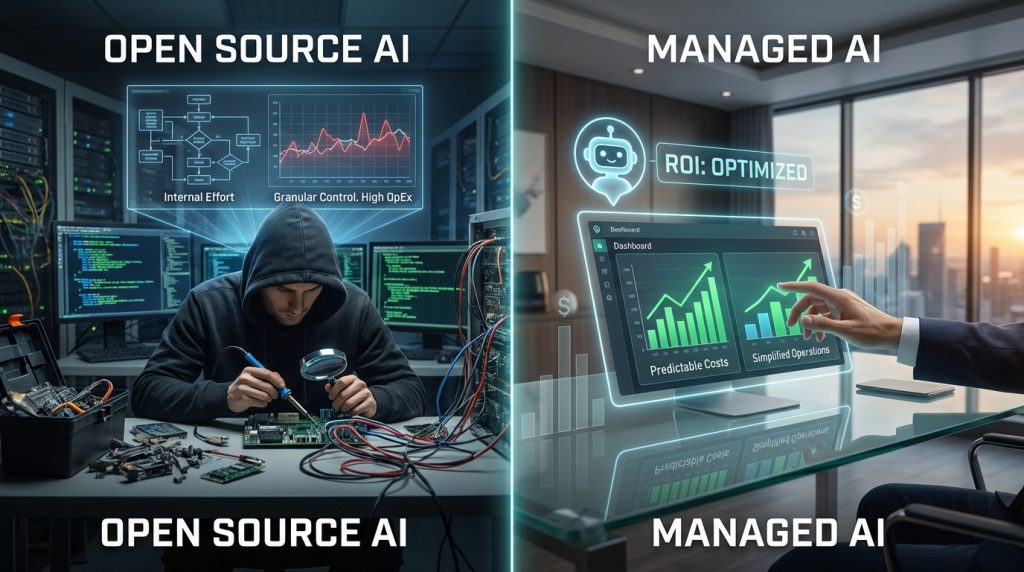
Think of it like being given a free puppy. The puppy itself costs nothing, but you are responsible for its food, shelter, vet bills, and training. Similarly, an open source model requires significant operational expenditure to become a valuable business asset.
Upfront vs. Hidden Costs: The Real TCO
The most significant cost in open source AI is often hardware. High-performance GPUs are essential for both training and running inference at scale. This can be a massive capital expenditure if you buy servers. Alternatively, it becomes a major operational expense if you rent GPU instances from cloud providers.In addition, you have infrastructure costs. This includes setting up networks, storage solutions, and deployment environments. Your team will spend considerable time configuring everything just to get the model running. Therefore, the initial engineering effort is substantial before you even see a return.
The People Problem: Talent and Expertise
Beyond hardware, the largest hidden cost is personnel. You need a specialized team of machine learning engineers, data scientists, and MLOps professionals. These experts are expensive and in high demand.Their job doesn’t end after the initial setup. For instance, they must constantly monitor performance, manage updates, fine-tune the model for your specific needs, and ensure uptime. This ongoing maintenance is a significant and perpetual cost center. The cost benefits of open source Stable Diffusion are only realized if you can manage this overhead effectively.
The Simplicity of Managed AI: Pay-as-You-Go Power
Managed AI services from providers like OpenAI, Google, or Anthropic offer a completely different approach. Instead of building everything yourself, you simply call an API. This drastically lowers the barrier to entry. As a result, your team can integrate powerful AI capabilities into your product in days, not months.The primary appeal is the lack of infrastructure and maintenance burdens. The vendor handles all the hardware, scaling, and model updates. You only need to manage your API key and your usage.
Understanding API-Based Pricing Models
Managed AI typically uses a pay-as-you-go pricing model. You might pay per 1,000 tokens (small pieces of text) processed or per image generated. This model is excellent for startups and projects with variable demand because costs scale directly with usage.However, this simplicity can hide a major financial risk. As your application grows, these small per-transaction fees can quickly multiply into a massive monthly bill. Without careful monitoring, costs can spiral out of control. Effective FinOps for API spend becomes crucial to avoid bill shock.
The Risk of Vendor Lock-in and Scaling Costs
Another key consideration is vendor lock-in. When you build your product around a specific provider’s API, it becomes very difficult and costly to switch. If that vendor raises its prices or changes its service, you may have little choice but to accept it.Furthermore, while the cost per unit is predictable, the total cost at scale can become much higher than a self-hosted solution. At a certain volume, paying API fees is like renting a house indefinitely when you could have built one for less in the long run. You are paying a premium for convenience.
A Head-to-Head Cost Comparison
To make a clear choice, it helps to see the costs side-by-side. Both approaches have distinct financial profiles that fit different business needs.
- Infrastructure Cost: Open source requires a high upfront or ongoing investment in GPUs and servers. Managed AI has zero infrastructure cost, as the vendor provides it.
- Talent Cost: Open source demands a costly, specialized MLOps and data science team. Managed AI requires only application developers who can work with APIs.
- Upfront Investment: Open source has a very high barrier due to setup time and hardware expenses. On the other hand, managed AI has a very low upfront cost.
- Scaling Costs: With open source, costs are more predictable at scale but require manual capacity planning. For managed AI, costs can become unpredictably high as usage explodes.
- Customization & Control: Open source offers complete control to fine-tune and modify the model. Managed AI provides very limited customization options.
- Speed to Market: Open source is slow, involving months of setup. Managed AI is extremely fast, enabling rapid prototyping and deployment.
Making the Right Choice: A CTO’s Decision Framework
The best path depends entirely on your company’s stage, resources, and strategic goals. There is no universally correct answer. Instead, use a framework based on your specific context.
When to Choose Open Source AI
You should lean towards open source AI if your company meets several of these criteria:
- Massive Scale: Your projected usage is so high that API fees would be astronomical.
- Deep Customization: You need to fine-tune a model on proprietary data for a unique competitive advantage.
- Data Privacy: Your application handles sensitive data that cannot be sent to a third-party vendor.
- Strong Engineering Team: You already have or can afford to hire the necessary MLOps and engineering talent.
When to Go with Managed AI Services
A managed AI service is likely the better choice under these conditions:
- Speed is Critical: You need to launch an MVP or new feature as quickly as possible.
- Limited Talent: You do not have an in-house machine learning team.
- Variable Workloads: Your usage is unpredictable, and you want costs to scale down to zero if needed.
- Prototyping: You are exploring AI capabilities and want to validate an idea without a large upfront investment.
Frequently Asked Questions (FAQ)
What is the biggest hidden cost of open source AI?
Without a doubt, the biggest hidden cost is talent. Finding, hiring, and retaining skilled MLOps engineers and data scientists is extremely difficult and expensive. Their salaries and the time they spend on maintenance, rather than new features, represent a massive ongoing operational cost that often dwarfs the initial hardware investment.
Can I switch from managed AI to open source later?
Yes, this is a very common and effective strategy. Many companies start with a managed API to validate their product and achieve speed to market. Once they reach a certain scale where API fees become too high, they plan a migration to a self-hosted open source model. However, this migration should be planned carefully, as it requires building the infrastructure and team in parallel before making the switch.
What is a hybrid AI approach?
A hybrid approach involves using both managed and open source AI for different tasks. For example, you might use a powerful, general-purpose managed API for complex, low-volume queries. At the same time, you could use a fine-tuned, self-hosted open source model for a specific, high-volume task to save costs. This strategy allows you to balance cost, performance, and flexibility effectively.
Conclusion: A Strategic Financial Decision
Ultimately, the choice between open source and managed AI is a strategic trade-off. It’s a balance between control and convenience, capital expenditure and operational expenditure. Managed services offer a low-friction entry into the world of AI, but that convenience comes at a premium, especially at scale.Conversely, open source provides ultimate control and potentially lower long-term costs, but it demands a significant investment in hardware, expertise, and time. As a CTO, your job is to analyze your company’s unique position and choose the path that aligns with both your technical roadmap and your financial reality.
