
DALL-E 3 vs SDXL Cost: A PM’s Guide to AI Images
Published on Tháng 1 19, 2026 by Admin

Understanding the Core Philosophies
Before comparing numbers, it’s essential to understand the strategic positioning of each model. Their cost structures are a direct reflection of their core philosophies. DALL-E 3 is a polished, ready-to-use product. In contrast, SDXL is a powerful, open-source toolkit.
DALL-E 3: The “Walled Garden” of Simplicity
OpenAI designed DALL-E 3 for ease of use and reliability. It’s integrated into products like ChatGPT Plus and Microsoft Copilot, making it incredibly accessible. This model prioritizes superior prompt understanding and consistent, high-quality output with minimal effort. For product teams, this means faster prototyping and less technical overhead. However, this simplicity comes at the cost of control and customization.
SDXL: The Open-Source Toolbox for Control
Stable Diffusion XL represents the open-source ethos. It offers unparalleled flexibility, customization, and control. Developers can run it on their own hardware, fine-tune it with custom data, and integrate it deeply into their applications. Consequently, this power demands significant technical expertise, hardware resources, and maintenance. The initial “free” price tag hides a more complex Total Cost of Ownership (TCO).
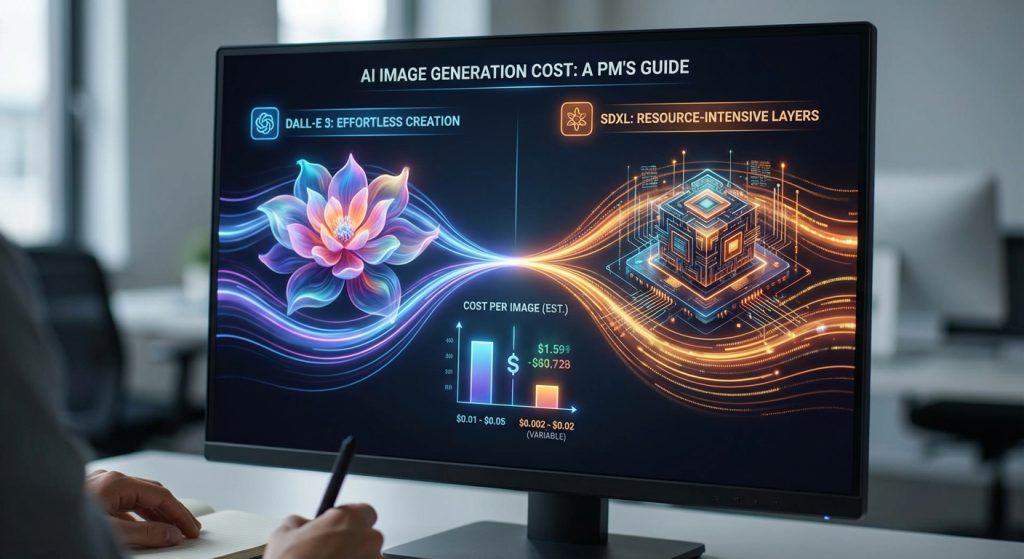
Direct Cost Comparison: Subscription vs. API vs. Hosting
The most apparent difference lies in how you pay for these services. Your choice will depend heavily on your expected volume and integration strategy.
DALL-E 3: The Predictable Cost Model
With DALL-E 3, costs are straightforward and predictable. This is a major advantage for financial planning and early-stage products.
- Subscription Access: For about $20/month, a ChatGPT Plus subscription provides access to OpenAI’s latest models, including their advanced image generation. This is ideal for internal use, ideation, and creating marketing assets.
- API Pricing: For SaaS integration, the API is your primary path. API costs for DALL-E 3 typically range from $0.04 to $0.12 per image, depending on quality and resolution. This model scales linearly with usage.
The Total Cost of Ownership (TCO) for DALL-E 3 is low to start, with no hardware investment or specialized engineering maintenance required.
SDXL: The Variable Cost Model
SDXL’s open-source nature makes its cost structure more complex. The model itself is free, but running it is not.
- Hardware & Hosting: To run SDXL yourself, you need powerful GPUs. This involves either a significant upfront capital expenditure on hardware or ongoing operational expenses for cloud GPU instances (e.g., from AWS, GCP, or Azure).
- Third-Party APIs: A popular middle ground is using a third-party API provider. These services manage the SDXL infrastructure for you. As a result, their API prices are dramatically lower, often between $0.002 and $0.05 per image.
Ultimately, SDXL offers the potential for the lowest cost per image at high volumes. However, you must factor in the costs of setup, maintenance, and the engineering talent required to manage it effectively.
Beyond Price-Per-Image: Hidden Costs and ROI
A savvy Product Manager looks beyond the sticker price. The true cost of integrating an AI model includes development time, customization effort, and the quality of the final output.
Development and Integration Costs
Time is money, especially in software development. DALL-E 3 offers a clean, well-documented API that allows for rapid integration. Your existing development team can likely handle it with minimal ramp-up time.On the other hand, SDXL is far more demanding. A self-hosted solution requires specialized machine learning engineers to deploy, optimize, and maintain the model. This significantly increases personnel costs and project timelines.
Customization and Control
This is where the trade-off becomes stark. DALL-E 3 offers very limited customization. If your product requires images that adhere to a strict brand style or a unique aesthetic, you may struggle to achieve consistency. This can lead to hidden costs in manual post-processing or user dissatisfaction.In contrast, SDXL’s greatest strength is its customizability. With techniques like LoRA fine-tuning, you can train the model on your own data to generate perfectly on-brand images. This control is a powerful competitive advantage, but it requires a dedicated investment in training and experimentation.
Quality and Prompt Adherence
Your API costs are directly tied to how many attempts it takes to get a usable image. DALL-E 3 and its successors are renowned for their ability to understand and execute complex prompts accurately. For example, recent models like GPT-4o have pushed this even further, as OpenAI has replaced DALL·E 3 with GPT-4o, a much more powerful multimodal model. This high adherence rate means fewer “re-rolls,” saving both time and money.SDXL’s out-of-the-box quality can be inconsistent. It often requires more detailed prompting and negative prompts to steer it correctly. Without fine-tuning, you may generate more unusable images, which drives up your effective cost per *successful* image.
Strategic Use Cases: Matching the Model to Your Product
The best model is the one that fits your specific business case. Here’s a framework for making that decision.
When to Choose DALL-E 3
DALL-E 3 is the ideal choice when your priorities are speed-to-market and ease of use. Consider it for:
- User-facing features where customers generate their own images.
- Internal tools for marketing content or presentation slides.
- MVPs and early-stage products where predictable costs are essential.
- Applications needing high-quality stock photos without complex technical setup.
When to Choose SDXL
SDXL shines when cost-at-scale and deep customization are non-negotiable. It’s the right path for:
- High-volume applications generating thousands or millions of images.
- Products requiring brand-specific visuals, like custom avatars or product mockups.
- Applications where data privacy is critical, necessitating local deployment.
- Teams with in-house ML expertise who can manage the infrastructure and optimize performance.
For teams scaling with AI, actively taming AI photo costs becomes a crucial part of your FinOps strategy.
Frequently Asked Questions (FAQ)
Is SDXL really free?
No. While the model is open source and free to download, running it incurs significant costs. You must pay for the powerful GPU hardware required, either through an upfront purchase or ongoing cloud hosting fees. Furthermore, you need to account for the salary of the specialized engineers needed to maintain it.
Which is cheaper for a startup?
It depends on the stage. For an MVP or a product with low image volume, DALL-E 3’s API is often cheaper and faster to implement. As your product scales, SDXL accessed via a third-party API can become more cost-effective. A self-hosted SDXL solution is typically only cost-effective at very high volumes.
What about commercial usage rights?
This is a critical area for due diligence. DALL-E 3’s commercial use terms are generally clear through OpenAI’s policies. SDXL, being open source, grants you rights to the model, but the legality can be more complex depending on the specific model version and the data it was trained on. Always consult with legal counsel.
How do the credit and cost systems compare?
DALL-E 3’s cost is tied to a direct price-per-image via its API. In contrast, the AI art ecosystem has many services built on Stable Diffusion. While detailed credit cost comparisons vary by provider, they often use a “credit” system where costs can fluctuate based on image size, steps, and other parameters, making direct comparison more complex.
Conclusion: Making the Right Financial Decision
The choice between DALL-E 3 and SDXL is not simply about which is “cheaper.” It’s a strategic decision that balances simplicity against control and predictable costs against scalability.Choose DALL-E 3 if your priority is speed, ease of use, and predictable spending, especially in the early stages of your product.Choose SDXL if your business model demands massive scale, deep customization, and you have the technical resources to manage its complexity.As a Product Manager, your task is to look at the complete picture. Analyze your product requirements, team capabilities, and long-term scaling plans. By understanding the Total Cost of Ownership for each model, you can make a data-driven decision that fuels innovation without breaking your budget.
