
AI Assisted Output: A Creative Director’s Guide
Published on Tháng 1 7, 2026 by Admin

Artificial intelligence is no longer a futuristic concept. Instead, it has become a powerful tool in the creative landscape. As a Creative Director, you are likely navigating this new terrain. You need to understand how to leverage AI without sacrificing quality or control. This guide explores AI-assisted output, a collaborative model where human creativity leads and technology follows.
This approach is not about replacing your team. On the contrary, it’s about augmenting their skills. By understanding the nuances of AI assistance, you can unlock new levels of efficiency and innovation. Therefore, let’s dive into what this means for your workflow, your legal rights, and your role as a creative leader.
What is AI-Assisted Output? The Core Distinction
It is crucial to understand the difference between two key terms. The conversation around AI often conflates “AI-generated” and “AI-assisted.” However, these concepts are fundamentally different, especially regarding creative control and ownership.
According to the World Intellectual Property Organization (WIPO), “AI-generated” refers to output created by an AI autonomously, without human intervention. The AI can change its behavior to respond to unexpected events. This is distinct from “AI-assisted” outputs that are generated with material human intervention and/or direction.
AI-Assisted: The Human in the Loop
AI-assisted output places the human creative at the center of the process. The AI acts as a sophisticated tool, much like a camera or design software. The final work is the result of a person’s vision, choices, and refinements.
For example, a designer might use an AI to generate a dozen initial logo concepts. The designer then selects the most promising one, modifies its colors, adjusts the typography, and refines the layout. The final logo is AI-assisted because human judgment was essential at every critical step.
AI-Generated: The Autonomous Machine
In contrast, an AI-generated work involves minimal human input beyond an initial prompt. If you ask an AI to “create a painting of a futuristic city” and accept the first result without changes, that output is largely autonomous. This distinction has significant implications for copyright, which we will explore later. For creative directors, the focus should always be on the assisted model to maintain creative integrity.
The Creative Director’s Role in an AI-Assisted World
The rise of AI-assisted tools doesn’t diminish your role; it evolves it. Your focus shifts from direct creation to strategic direction and curation. You become the conductor of an orchestra where some musicians are human and others are algorithms. Your primary tasks now include steering the AI and verifying its output.
A recent study on AI-assisted data analysis highlighted serious challenges in verifying AI-generated results and steering the AI effectively. This underscores the need for active human management in the creative process.
From Prompting to Curating
The creative process is no longer linear. It is an iterative dialogue between your team and the AI. This involves:
- Defining Objectives: Clearly setting the goals, brand constraints, and desired emotional tone.
- Input Selection: Choosing the right data, images, or text to guide the AI.
- Iterative Prompting: Crafting and refining prompts to explore different creative avenues.
- Curation and Selection: Critically evaluating the AI’s suggestions and selecting the elements that align with your vision.
- Human Refinement: Applying the final creative touch, making adjustments that only a human can.
A Chinese court case, *Shenzhen Tencent v. Shanghai Yingxun*, granted copyright protection to an AI-assisted article because the creative team was deeply involved in the input, selection, and arrangement of the content. This proves that a documented, human-led process is your strongest asset.
New Tools for a New Workflow
Modern platforms are being built around this collaborative model. For instance, Google’s AI-assisted tools in BigQuery help data analysts by suggesting ways to clean and transform data. The AI provides intelligent guidance, but the analyst makes the final call. This approach helps automate tedious tasks, allowing your team to focus on high-level strategy and creativity. By handling the heavy lifting, your team can focus on the creative decisions that matter, leading to a new era of intelligent process tech in your studio.
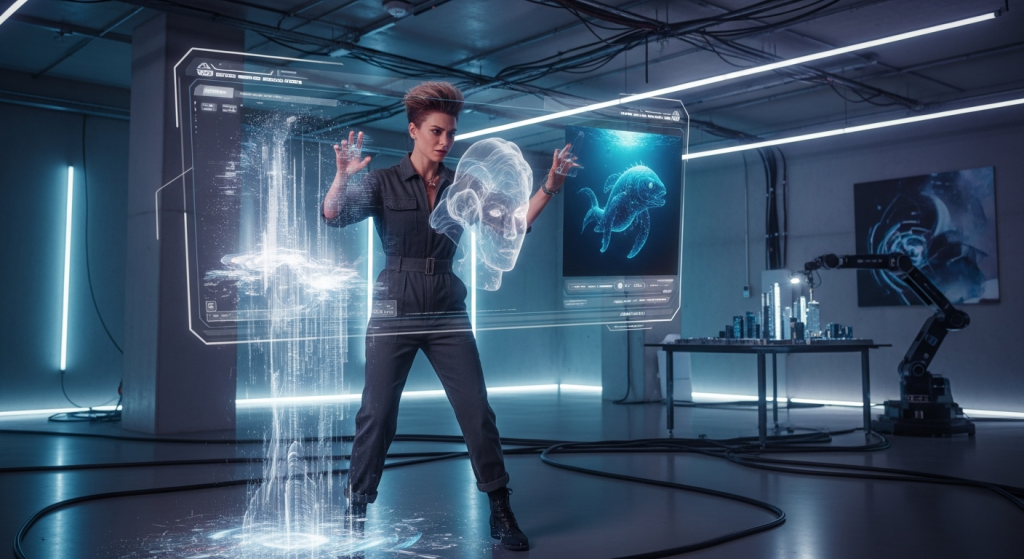
These tools often feature visual, low-code interfaces. As a result, they empower team members with varying technical skills to contribute effectively, fostering a more inclusive and efficient creative environment.
Navigating the Legal Landscape: Ownership and Copyright
One of the biggest questions for creative directors is: who owns AI-assisted work? The answer is complex and varies by jurisdiction, but a clear pattern is emerging. Copyright law is built on the foundation of human creativity.
Most copyright systems, including those in the U.S. and the EU, require a work to be the product of a human author to be protectable. This is where the distinction between “assisted” and “generated” becomes legally critical.
The Human Authorship Requirement
The U.S. Copyright Office has been clear. It has refused to register works produced autonomously by AI without any human involvement. It states that a work must be the result of an author’s “own original mental conception.” A machine cannot have a mental conception.
Similarly, legal analysis in the European Union suggests that current EU copyright rules are generally suitable and sufficiently flexible to handle AI-assisted output. The key is whether a human has exercised “creative freedom” during the process.
Is Your AI-Assisted Output Protected?
For your work to be copyrightable, you must demonstrate significant human creative input. Simply writing a prompt and accepting the output is not enough. You must show that your team made creative choices.
This includes:
- Selecting from multiple AI outputs.
- Arranging AI-created elements in a new, original way.
- Substantially modifying the AI’s output.
- Combining AI elements with original human-created work.
Essentially, the more you and your team are involved in shaping the final product, the stronger your claim to authorship and copyright protection.
The Risks and Challenges You Can’t Ignore
While AI-assisted output offers incredible opportunities, it also comes with significant risks. As a Creative Director, your job is to mitigate these challenges to protect your brand and your work. Two of the most pressing issues are data bias and the “black box” nature of some AI systems.
The Bias Trap: Garbage In, Garbage Out
AI models are trained on vast datasets from the internet. If this training data is skewed or contains societal biases, the AI’s output will reflect and amplify them. Medical AI tools, for example, have shown bias when trained on skewed clinical data. This same principle applies to creative work.
An AI asked to generate images of “a successful leader” might predominantly produce images of one gender or race. Using such output can lead to brand damage and alienate your audience. Therefore, you must critically vet both the tools you use and the content they produce for hidden biases.
The “Black Box” Problem: Verification and Control
Another challenge is the difficulty in understanding how an AI arrived at a specific output. This is often called the “black box” problem. Without transparency, it’s hard to verify the originality of the work or ensure it doesn’t inadvertently infringe on existing copyrights.
This lack of control is a major concern. To address it, researchers are developing systems that break down tasks into smaller, verifiable steps. This gives the human user more control and makes it easier to intervene and correct the AI’s course. As a leader, you should favor tools that offer more transparency and user control.
Conclusion: Your Role as a Creative Visionary
AI-assisted output is not a threat to creative leadership; it is an evolution of it. This technology is a powerful partner that can handle tedious tasks, spark new ideas, and accelerate your workflows. However, it requires a human hand to guide it.
Your role as a Creative Director is more vital than ever. You are the strategic visionary who sets the direction, curates the output, and ensures the final product is original, ethical, and aligned with your brand’s values. By embracing a model of human-led, AI-assisted creation, you can empower your team to reach new creative heights while maintaining the integrity and quality that define your work.
Frequently Asked Questions
What is the main difference between AI-assisted and AI-generated output?
AI-assisted output involves significant human intervention, where a person guides, selects, and refines the work created with an AI tool. In contrast, AI-generated output is created almost entirely autonomously by the AI with minimal human input beyond an initial prompt.
Can I copyright creative work my team makes using AI tools?
Generally, yes, if the work is AI-assisted. Copyright protection depends on the level of human authorship. If your team makes substantial creative choices—like selecting, arranging, and modifying the AI’s output—the resulting work is likely protectable. Works generated fully by an AI without human creative input typically cannot be copyrighted.
How can I prevent bias from appearing in my team’s AI-assisted work?
Preventing bias requires a proactive approach. First, research the AI tools you use to understand their training data. Second, train your team to critically evaluate all AI outputs for hidden social or cultural biases. Finally, ensure your creative process includes diverse human oversight to catch and correct any biased content before it is finalized.
Will AI-assisted tools eventually replace my creative team?
It is highly unlikely. AI tools are best at executing tasks and generating options, but they lack the critical thinking, emotional intelligence, and strategic vision of human creatives. The future of creative work is a collaboration where AI handles repetitive tasks, freeing up your team to focus on strategy, curation, and high-level conceptual thinking.
